Lauri Stallings’ civic action blooms in Palmetto
Since launching her movement platform, glo, in 2009, choreographer Lauri Stallings’ work has evolved to include civic action in rural communities such as Palmetto, a small town in Georgia’s South Fulton County.
Lauri Stallings is welcoming guests to her 120-year-old home in Palmetto for an event she calls the “Fete.” It’s a hot, humid Friday evening in June.
She walks over to guest Jerry Thomas, who’s sitting in one corner of the front room. He’s a lawyer and art consultant whose collection includes works by Romare Bearden and Thornton Dial. He asks Stallings why she wears such large shoes. We all look down. Her shoes are indeed enormous — clunky, black and shiny, with large laces and thick soles. They seem out of sync with her thin legs and long dress.
Stallings tells us about the indignities her feet experienced when she was a ballet dancer with Vancouver’s Ballet BC, bound and squeezed into pointe shoes night after night, and then the shoulder and knee injuries she incurred as a contemporary dancer with Chicago’s Hubbard Street Dance Company. These shoes give her feet and legs support and ease, she says.
Thomas’ wife, Andrea Young (executive director of the Georgia chapter of the ACLU and daughter of former Atlanta Mayor Andrew Young) suggests that the shoes may also be part of the choreographer’s unique style. Stallings smiles and nods, touching Young on the shoulder.
Stallings is founder of the Atlanta-based, all-female glo platform that began in 2009 primarily as a dance creation and producing entity — on stages and in outdoor spaces — but over the years has evolved to include a commitment to social and spiritual revitalization in rural communities. Her personal style, seen here at the Fete, could be described as windswept creative. No makeup. Long, slightly wild hair bunched back as if in haste. And always a long dress and large shoes. She greets the 40 or so people she’s invited with big, lingering hugs and hopes they share her vision of bringing people together and sowing seeds of change.
While no speeches are made, this is a gathering with purpose, part of The Blooming City, a project Stallings birthed in Palmetto to help transform the community, break down barriers and create joy. It consists of land art (think wildflowers), conversations, art education, installations, concerts and more. “Palmetto is trying to just do better,” Stallings explains. “As artists, we need to keep showing up there.”
The evening begins with Vinisha Browne, a glo moving artist, reading a poem. As she starts to speak, a freight train blares its horn and grinds noisily along the tracks across the street from Stallings’ front door. Browne raises her voice and finishes her poem.
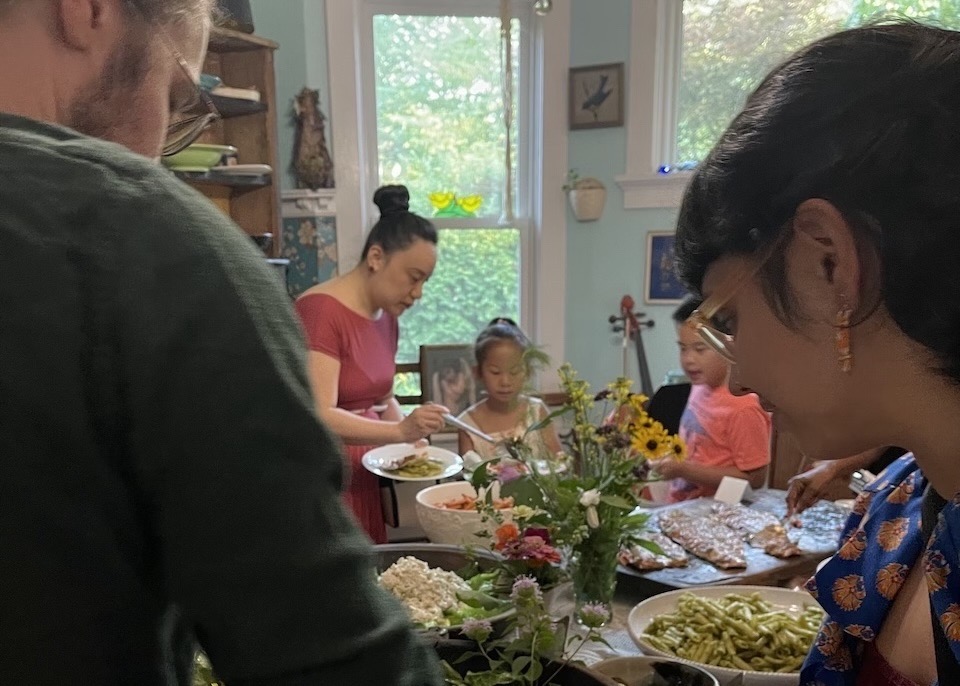
The serve-yourself food in the dining room is catered by Marie Lupo Nygren. She and her ex-husband, Steve Nygren, founded Serenbe, the affluent planned community just a nine-minute drive away but as distant culturally, racially and economically as Buckhead is from Atlanta’s south side.
Steve is at the Fete, too, as are a Chattahoochee Hills council woman, members of Palmetto’s new arts council, an architect, a vocalist, artists and many more. Some guests drove down from Atlanta. Some are local. It’s a diverse crowd, racially, generationally and professionally.
Palmetto’s mayor, Teresa Thomas-Smith, is here, her hair in braids, her wrists weighty with bracelets. Her silver sequined sneakers catch the light as she walks. She was sworn into office on January 1, 2024, the first woman and the first African American to serve as mayor of the 170-year-old township. A year earlier, as a city council member, she created the Cultural Arts Committee but could not get support from the previous mayor or Council, with the exception of Councilwoman Jess Wilbanks, and no funds were made available. Now, under her watch, there is funding.
In Atlanta, which has a 50-year-old city-run arts council, this might not be a big deal, but, in Palmetto, it is a very big deal. The previous mayor, J. Clark Boddie, served for 34 years, and his sights were not focused on the arts.
The three members of the arts council at the Fete are African American women, all Palmetto natives. They were among the 12 people who came to the first meeting of the council, the mayor explains. “Lauri was there. She is so airy and light and kind. We need empathy and kindness and compassion. Lauri is genuinely in that space. We recognized that instantly.”
Grass, flowers and kindness
She’s so kind. You hear that a lot about Stallings.
Erin Dougherty, director of public engagement at the High Museum of Art in Atlanta, remembers when in 2019 Stallings sent each of the dozens of people who worked on her multimedia museum project Supple Means of Connection a hand-written thank you card, each with a delicately pressed flower inside.
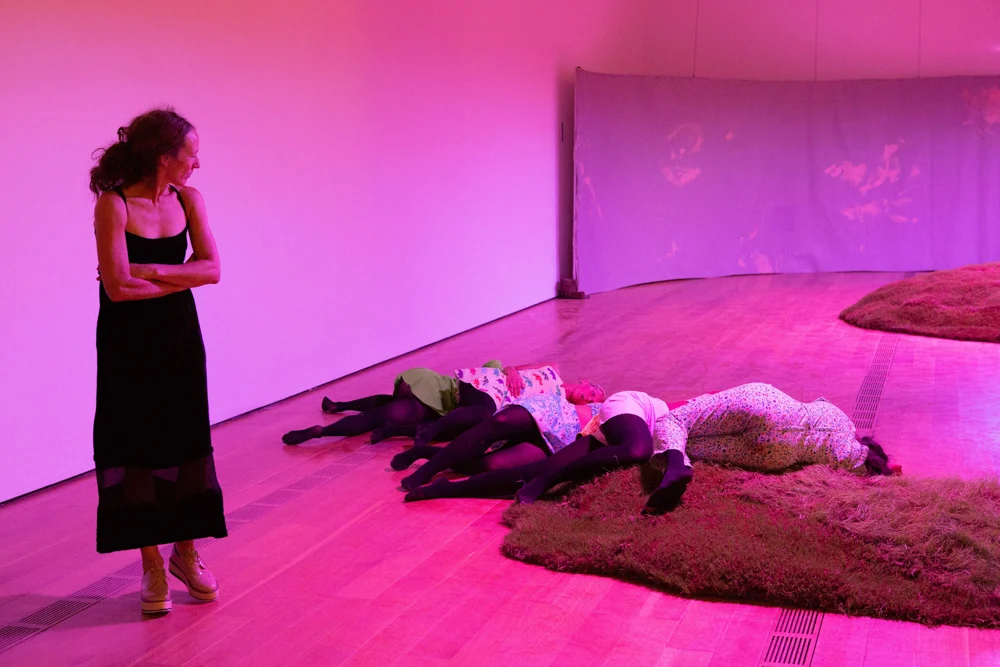
Stallings was the High’s first resident choreographer. Her five-week Supple residency included movement, neon art and mounds of grass to lounge upon.
Yes, real grass. Museums have strict rules about many things, one of them being no grass in the galleries. Too messy. Too many bugs. Too much work to keep it alive. But Stallings prevailed. The grass went in the gallery.
In Palmetto, Stallings has turned that concept inside out — literally. Instead of asking people to experience grass inside an urban arts institution, she is inviting them to participate in nature on its own terms — outdoors.
That means sowing wildflower seeds in plots around town as a community event and watching them grow. Stallings believes everyday acts like this deserve to be reframed as rite, as ceremony. It’s a way of bridging the gap between art and life, and encouraging people on different sides of the town’s entrenched social divides to enjoy one another’s company.
Stallings and her partner of 30 years, Rick Carvlin, bought their Palmetto home in 2020. Thomas-Smith and her husband Antone Smith moved there from Atlanta 16 years earlier, hoping the community would develop into a “cute little town like you see in a Hallmark movie.” Instead Palmetto continued to devolve. Downtown became a ghost town. “We have been so antiquated for so long in the city,” Thomas-Smith says. “We are a relic of the 1970s. How do we bring our city back to life?” Stallings’ ideas appealed. “When you think about The Blooming City — flowers are life.”

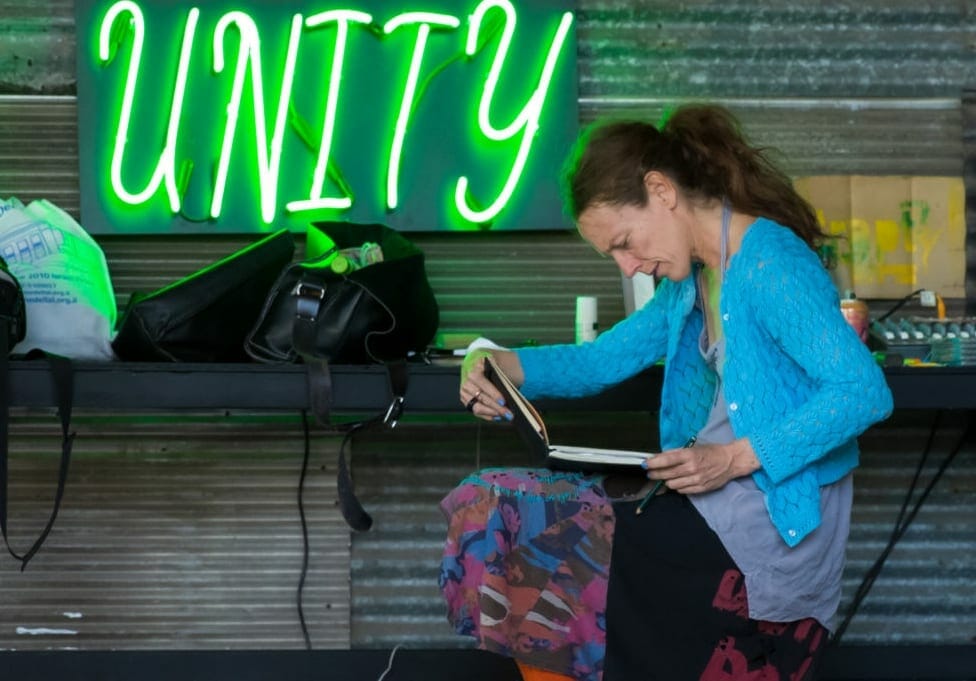
Thomas-Smith has been accused of bringing big city ideas to Palmetto. “It feels like people want to keep it the way it was when it was unwelcoming and uninviting.” That didn’t sit well with her. So when Stallings suggested installing two neon sculptures at City Hall, the mayor immediately said yes. One is the word “Harmony,” the other spells “Unity,” the last five letters of the word community, the mayor notes. Some people love them, she explains, some people say it makes City Hall look like a liquor store.
Stallings and Thomas-Smith are now good friends. Stallings’ interactions with former Mayor Boddie in 2021 were less pleasant. She tried to contact him to tell him that glo would soon be visible in town. He never took her calls. But one day, when Stallings and moving artist Mary Jane Pennington were going door to door delivering glo-made play kits for kids — a drink, a snack, a toy, in soft fabric bags, “the softest things you can imagine,” Stallings says — he showed up, lights flashing on the roof of his car, to ask what they were doing.
He had decided, it seems, that walking up to residents’ doors uninvited was akin to trespassing. No tickets were given, but it was an indication that Palmetto then was not used to outsiders doing new and different things. And Stallings is all about doing new and different things.
Pennington, a glo moving artist since 2009, says of their work together: “There is no separating art and life — we are creative forces at all times. And there is a responsibility as a moving artist. What are you communicating? What are you gifting and receiving? We are not leaving any part of ourselves out, and we are not leaving anyone else out . . . Lauri is so spacious, always working from a regenerative space.”
Twelve years ago, after establishing herself as a fiercely original creative force in Atlanta, Stallings challenged her board: We have to get out of Atlanta, she said. “Many rural communities have been left behind, both in cultural opportunities and basic needs because of hindered economic mobility.” She wanted to give people in these communities “things to feed their souls — creativity.”
The result was The Traveling Show, which launched in 2013. It’s a long-term project that engages rural Southern communities through movement, conversation, kindness. Over the years, it has visited 50 small Georgia towns. The Blooming City in Palmetto is a separate project but is imbued with the same dedication to social action in a rural space. And while Stallings and Carvlin are still very active in the Atlanta arts scene — he is senior stage manager with the Atlanta Symphony Orchestra; she is developing a new movement work inspired by the poetry of Lonnie Holley — Palmetto is now their home, their community. Perhaps that’s why The Blooming City feels so intimate.
Stallings learned about civic action early. She describes herself as a Civil Rights child, the daughter of “wildly expansive” hippie parents who lived “in the margins” in a historically Black neighborhood in Gainesville, Florida. Her father was the vice president of a local union. Their yard was frequently full of yard signs championing Democratic candidates, while her father rode around town in his truck with a megaphone, blasting out their names.
Dance took her out of Gainesville and into life as a performer and choreographer for major national and international companies, including as resident choreographer at Atlanta Ballet from 2005 through 2008. When that residency ended, she decided to stay in the city and “research a multifaceted practice.”
That practice soon included art as civic action, developed and curated through mapping, a process similar to those used by choreographers Anna Halprin, Yvonne Rainer and Merce Cunningham, Stallings explains. This visual language of maps guides and informs her work in Palmetto and can be constantly reconfigured to include multiple projects. The word dance is nowhere on The Blooming City map; instead, it illustrates a different kind of movement, from separation to relationship and inclusion.

Stallings also draws from the work of scholars, humanists and art historians such as Joseph Beuys, the 20th century German art theorist who believed art has the potential to transform society, and Donna Haraway, the ecofeminist and author of Staying with the Trouble: Making Kin in the Chthulucene. Haraway writes: “Staying with the trouble means making oddkin; that is, we require each other in unexpected collaborations and combinations, in hot compost piles. We become — with each other or not at all.”
Stallings’ copy of the book is well used. “If we don’t take care of each other, we’re not going to make it,” she says. “We are not coming together to perform; we are coming together because we must.”
Music blooms in Palmetto
It’s a Friday evening in August outside the Palmetto Historic Train Depot, an imposing brick building by Palmetto standards, although the faded green paint on the doors is peeling in places. Across the street is a small plot of wildflowers next to a Blooming City yard sign. They are growing there because Stallings organized four community sowing days back in April 2024.
The Depot was originally a freight and passenger station for the Atlanta & West Point Rail Road in the 1850s. Many years later, it housed the local jail, then City Hall. It was renovated in the early 2000s and reopened as the Historic Train Depot in 2012.
Inside is a small, musty, long-past-its-prime museum. Next to that is a multipurpose room, its old floorboards worn to a sheen, where this evening a loose semicircle of folding metal chairs has been set up.
And here’s Carvlin, holding a stepladder and looking like the resident custodian. It’s at times like this, in the pregnant quiet before a glo event, when Carvlin is the earth to Stallings’ air — the dependable banks to her torrent of creative energy. Tonight he is preparing the space for Palmetto’s first Blooming City concert. It’s free and has been advertised throughout downtown with brightly colored flyers taped onto windows, many of them looking out from empty, neglected storefronts. This room is also where the fledging arts council meets, Carvlin says.
In a few moments, he will help Elisabeth Remy Johnson, principal harpist with the Atlanta Symphony Orchestra, roll her instrument in from her car. He will make sure the lights are working on the music stands for Johnson and ASO principal flutist Christina Smith. There’s a sign-in sheet on a small table, a basket full of fresh flowers on the floor and a deck behind the building where bottles of wine, cans of soda and plastic glasses are laid out on a small table, ready for intermission.

The railway track runs right behind the building, and before the concert begins, a freight train screeches and lumbers past. “Writer James Baldwin said follow the train tracks alongside the rivers, and you’ll hear the stories of the American South,” Stallings says. “I want us to feel them, embody them, welcome them.” This railroad line not only runs past the Depot and her home here but provides the soundscape to the Goat Farm’s Goodson Yards in Atlanta where glo performed for several years and will re-inhabit this fall after the venue’s renovation is complete. It’s as if the railroad is an artery, connecting her work then and now.
Both the musicians are wearing long dresses strewn with flower patterns. Stallings is at the back of the room, talking quietly with the mayor, who’s wearing a lavish gown with bigger flowers.
Little by little, audience members arrive — young and old, Black and white, some familiar with classical music, some not. There are grandmothers and grandchildren. They arrive even though, as Stallings explains, some Black residents have resisted going into the building because the museum is dominated by documentation and historical photographs celebrating Palmetto’s white citizenry. As of 2022, the city’s population of 4,650 was more than 55% African American.
The African American woman sitting behind me loves music, she says — country, gospel — and is excited about the idea of a concert in downtown. There’s an air of anticipation for this new thing.
“This is the first time I’ve seen a harp in Palmetto,” my other neighbor whispers. He’s white, probably in his 70s, lots of white hair. He’s been around Palmetto since his parents bought an 8-acre spread here in the 1960s, so he knows the town.
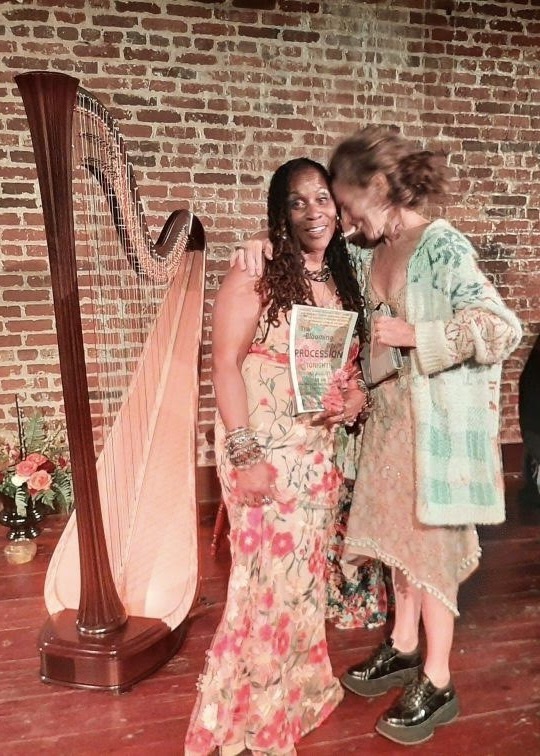
Stallings, wearing those trademark huge shoes below a dress that sparkles, welcomes the capacity crowd. The music isn’t readily familiar, even to people who know classical music, but the concert atmosphere is casual and includes a show-and-tell moment when the harpist turns her instrument toward the audience to demonstrate how the pedals at the base of a harp control the pitch of the strings. We are a long way from Symphony Hall.
During intermission, a man walks up to Stallings and thanks her for the eggs and flowers that she dropped off at his front door recently. She left before he could thank her, the man explains. Stallings, it seems, is everywhere at once, doing unexpected things. They hug.
Moments after the last notes of Astor Piazzolla’s “Histoire du Tango” fade away, after the audience stands and applauds, the mayor, resplendent in her long, flowered gown, thanks people for coming, says she is trying not to cry and notes how this concert is part of a “seismic shift” for the building and for the town. She will make a note of it in her gratitude journal she says.
It’s clear this evening that Stallings’ activism is not about changing policy but gently bringing people together.
“They can argue all they want about policy,” she writes. “I acknowledge that with grace, but I know that art can figure shit out that no policy can. Art can navigate and bend and swarm with such love and compassion. Sometimes the work is didactic; sometimes it’s ephemeral and abstract. I just know that for these rural spaces, far from the center, art offers hope. It’s their North Star.”
::

Gillian Anne Renault is ArtsATL’s senior editor for music and dance and has been an ArtsATL contributor since 2012. She covered dance for the Los Angeles Daily News, Herald Examiner and Ballet News and on radio stations such as KCRW, the NPR affiliate in Santa Monica, California. Many years ago, she was awarded an NEA Fellowship to attend American Dance Festival’s Dance Criticism program.
STAY UP TO DATE ON ALL THINGS ArtsATL
Subscribe to our free weekly e-newsletter.

PLEASE SUPPORT ARTSATL
Your Gift Sustains the Coverage You Count On!
Related Posts