Period authenticity is key in Atlanta Baroque Orchestra’s take on a Monteverdi masterwork
The ensemble takes on the era-straddling Vespers, a crucial yet rarely performed work in the classical canon, at the Cathedral of St. Philip.
::
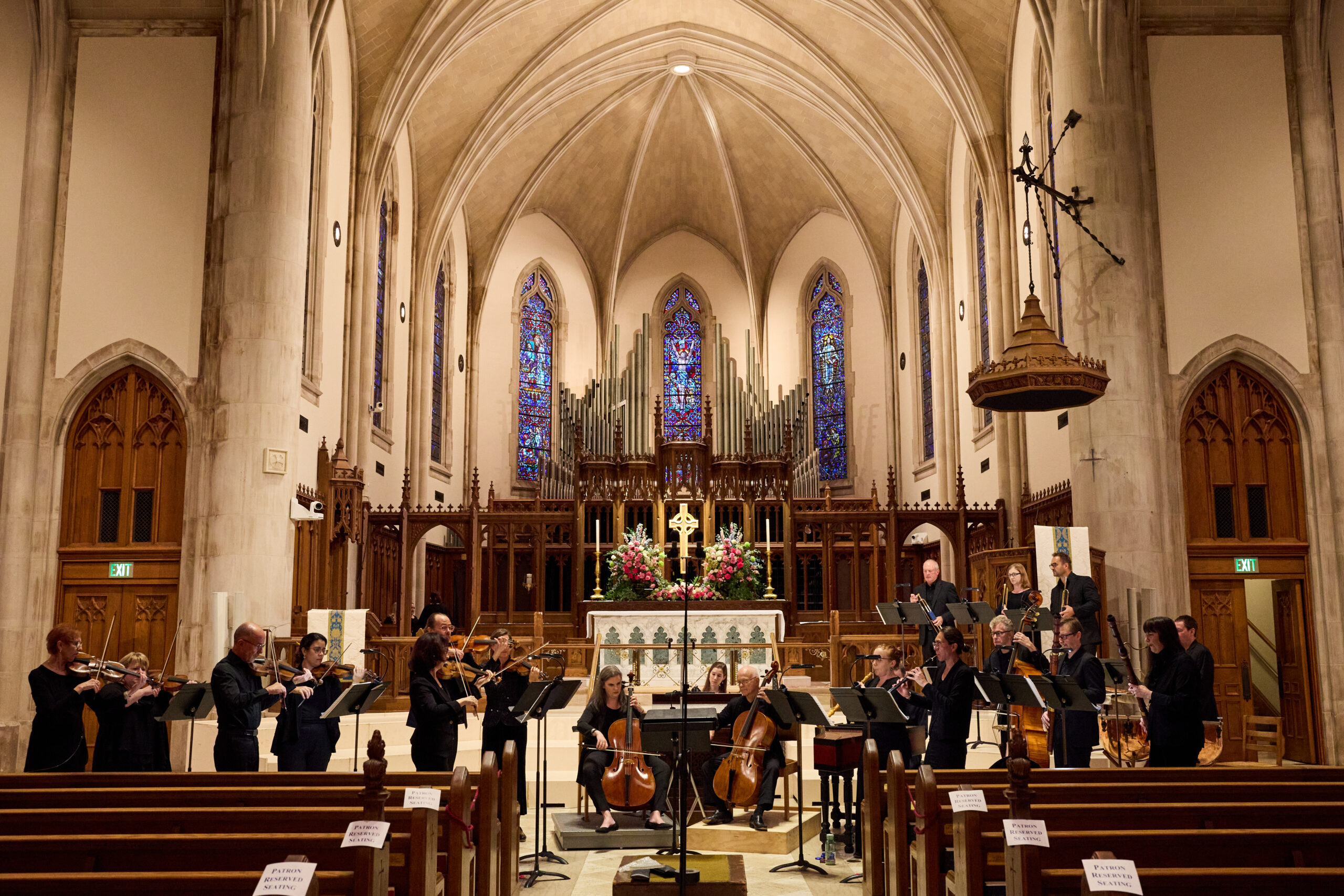
When the Atlanta Baroque Orchestra presents Claudio Monteverdi’s Vespers on March 28 and March 29 at the Cathedral of St. Philip, it will be a rare opportunity to hear a transformative work in the history of music played authentically.
Most orchestras are content to have their performances of the classics refracted through modern technology, architecture and instrumentation. Symphonies perform in acoustically sculpted halls designed to optimize their sound, opera singers are carried over PA systems and violins are usually strung with steel, nylon or composite fiber as opposed to strings derived from animal intestines. Those innovations optimize the listening experience, but they also distort the genuine experience: We hear a modernized re-invention of the composition, not the reality of what was heard hundreds of years ago.
For the Atlanta Baroque Orchestra, period-accurate authenticity is the name of the game. For 26 seasons, the ABO has been delivering performances that are as enthralling as they are painstaking in their detail. As the Cathedral of St. Philip artist-in-residence since 2016, the ensemble has become adept at making bold and effective use of the space.
“This will be one of the largest baroque string orchestras that we’ve ever had at the cathedral,” enthuses Vespers conductor and St. Philip’s Canon of Music Dale Adelmann. “All of the instruments that will be used are either original from the 17th or 18th centuries or they’re exact copies.” He goes on to emphasize that the performance will feature all the detailed accoutrements of a baroque-era performance, down to the use of catgut strings.
That attention to detail alone makes the ABO a compelling concert draw, but Vespers is significant in its own right. “It is an amazing piece that changed the history of music,” explains ABO Artistic Director Julie Andrijeski. “It was one of the first pieces to be on the cusp of modern music.”
Written in 1610, the composition marked a crucial shift from the Renaissance to the baroque era with its emphasis on solo voices over ensemble. “It’s a transition,” explains Adelmann, “from a style of music where all of the voices are equally important and the lines interweave. It’s accompaniment and solos as opposed to equally important.”
That shift toward soloist-driven music would emerge as a central and ever-evolving feature of classical writing moving forward to such a degree that Andrijeski and Adelmann are both quick to identify it as one of the most important pre-Bach developments in the history of composition. For all that impact, it remains a rarely heard piece from a performance standpoint, with Adelmann saying it’s been about 50 years since the piece was last performed in Atlanta.
Nevertheless, Adelmann emphasizes that the work’s appeal goes well beyond its notable historicity and into the dramatic use of the acoustic space. “There are just constant changes of instrumentation and voices- in the second half; we even move around the building. There will be constant changes of performing voices and style that really keep the energy up throughout the entirety of the piece.”
That dramatic staging and sonic atmosphere come coupled with a bevy of period instruments. “Some of the fascination will be to see these ancient instruments that you just never have a chance to hear otherwise,” he observes, pointing out the use of sackbuts, cornettos, two theorbos, a baroque harp and continuo organ.
The wide, sprawling sonic palette that is Vespers comes from its origin as a job application of sorts for Monteverdi. “It seems most likely that he was looking for a job at the Vatican with the pope or with a member of the curia,” says Adelmann. As such, the work is designed to showcase Monteverdi’s range with elements of every stylistic convention popular in the time period.
The result is a sprawling, labyrinthine epic with much room for interpretation. “Monteverdi is intentionally trying to show off that he is a master of every conceivable compositional style,” Adelmann points out. “And so the score is, in many cases, completely vague about who is supposed to do what. And the reason for that is, most likely, so that the piece could be performed by whatever pieces you had on hand.”
With that in mind, Adelmann aims for the Atlanta Baroque Orchestra’s performance to be the grandest possible realization of Monteverdi’s vision. “It’s been a tremendously huge project,” he says, his enthusiasm infectious. “But it’s going to be very, very exciting.”
Where & When
Atlanta Baroque Orchestra performs Monteverdi’s Vespers at the Cathedral of St. Philip — 7:30 p.m. March 28 and 3 p.m. March 29.
::

Jordan Owen began writing about music professionally at the age of 16 in Oxford, Mississippi. A 2006 graduate of the Berklee College of Music, he is a professional guitarist, bandleader and composer. He is currently the lead guitarist for the jazz group Other Strangers, the power metal band Axis of Empires and the melodic death/thrash metal band Century Spawn.
STAY UP TO DATE ON ALL THINGS ArtsATL
Subscribe to our free weekly e-newsletter.

PLEASE SUPPORT ARTSATL
Your Gift Sustains the Coverage You Count On!
Related Posts