PushPush Arts a key player in a beehive for the arts taking shape in College Park
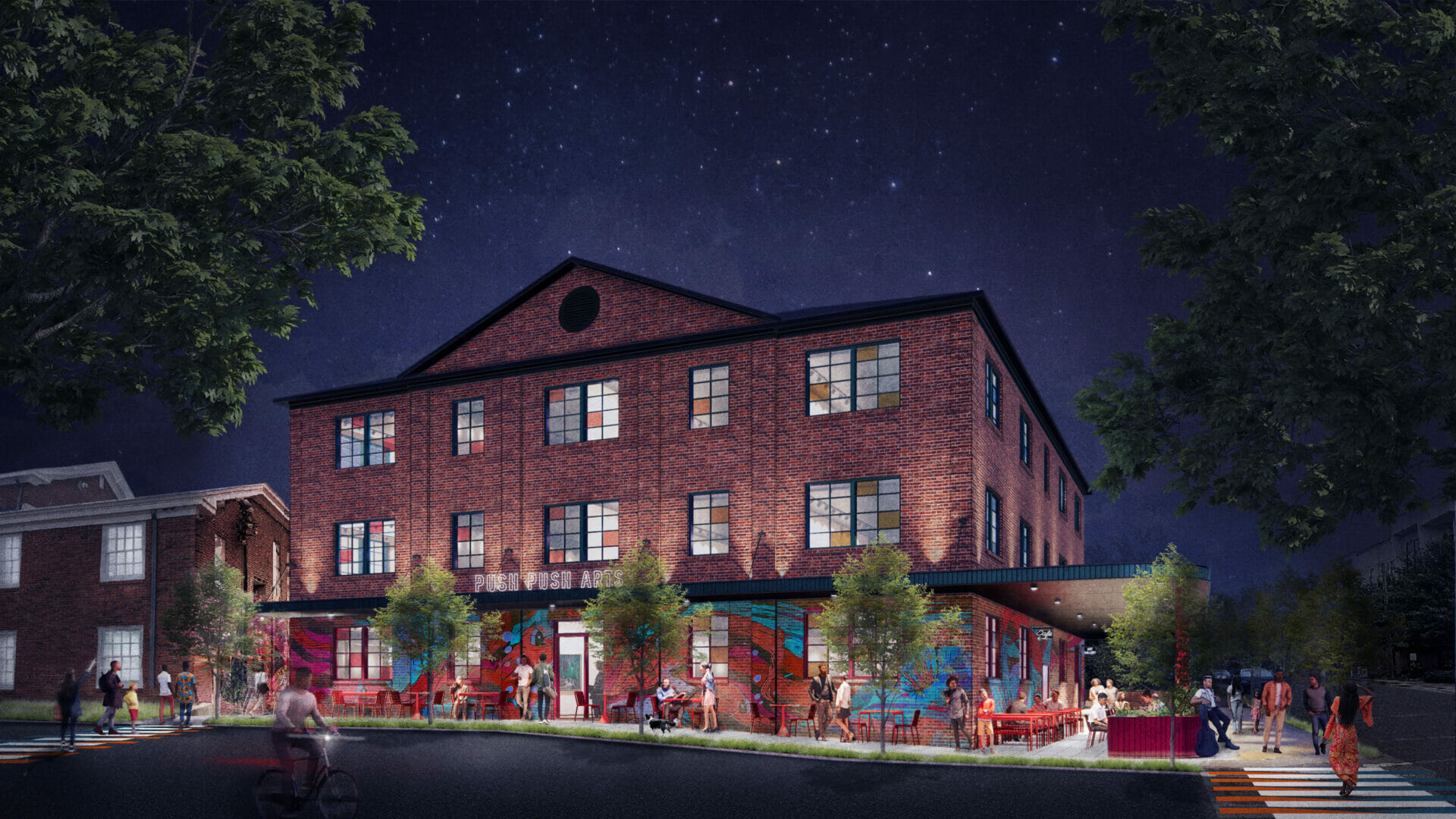
Since 1997, PushPush Arts has made space for artists of all disciplines to find their own voices and discover their own paths. And now the group’s leaders are working with multiple partners in College Park and the south metro city itself to create an arts cooperative with affordable housing and studio space for artists in its downtown, where PushPush moved in 2019.
Located near the city’s MARTA station and the Hotel Indigo downtown, the College Park Arts Campus is redesigning a group of adjacent church buildings to create a mixed-use development intended to foster an artistic community.
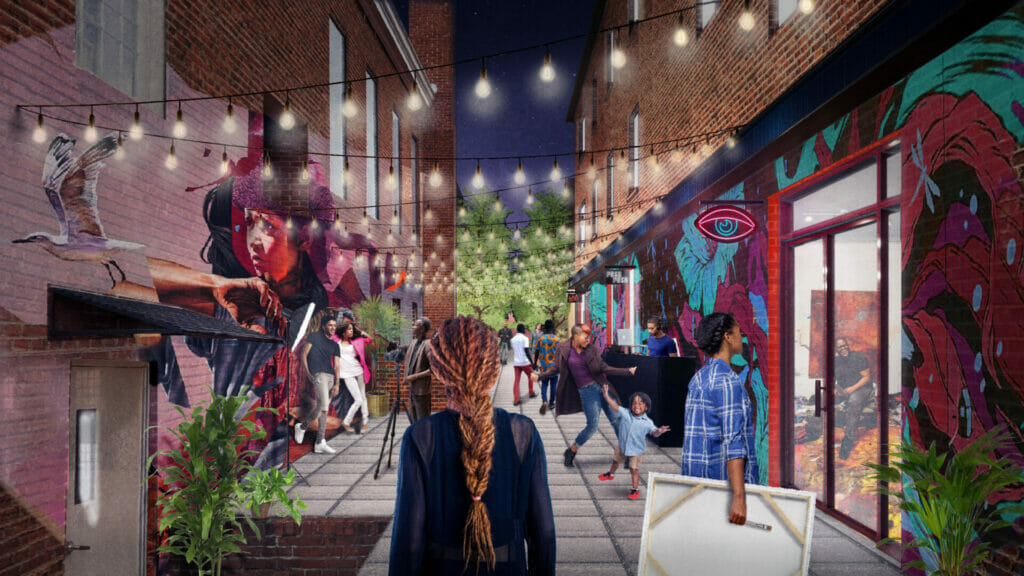
The undertaking, conceived by First United Methodist Church of College Park, is multi-phased and ambitious. Plans show performance spaces, an art walk, gallery space and retail shops on the campus in addition to living quarters.
PushPush currently operates a theater and has office space in a building at 3716 E. Main Street. The company also is working with partners to renovate a three-story brick building at 1805 Harvard Avenue.
So far, for its part, PushPush, as the official arts partner in the College Park Arts Campus endeavor, has raised around $250,000 with the support of donors including AEC Trust and the Tull Foundation.

PushPush investigated the possibility of buying and renovating the Harvard Avenue building “so that we can control prices,” said Habeger, who launched the troupe with his wife, Shelby Hofer.
“We moved down here with the idea of becoming more sustainable or that the arts could become more sustainable,” Habeger added. “One of the reasons for buying (the building) was to create a co-op. We want people to own their own work, their own practice and their own style. And own things like housing and own things that can increase their sustainability.”
The organization has a history that suggests it can accomplish these ambitions. PushPush has cultivated successful writers, performers, playwrights and filmmakers. While based in multiple locations including Little 5 Points and Decatur over its long history, the organization has staged and promoted shows across metro Atlanta, providing space for groups and shows such as Write Club Atlanta, improv performances, experimental theater and even puppetry.
On July 23, PushPush held an open-house event at the developing campus to show the community the artists at work.
“We really wanted to let people know that we are here and that there’s a lot of work going on in the background,” Hofer said during the event. “We want people excited that we are building something pretty cool. … It’s all going to be different next year, but this was to give people an early look to see that we’re still at it.”
Currently, Habeger said 100 artists use PushPush’s studio space to develop work everyday. This includes painters, dancers, milliners and filmmakers.
And SeedWorks, the company’s artist-incubator project accepting pitches, helps creators turn their ideas into concrete work.

Habeger said that PushPush nurtures artists by encouraging collaboration, giving them space to express their voice and, most importantly, “getting out of their way.”
“The question is such a great one right now, ‘Why is my voice important?’ from so many different angles, from appropriation to leadership to statesmanship,” he said. “It’s a great question, and I feel more compelled to champion that everyone’s voice is important right now, even more. I want people to write. I want Black people to write about White people. I want men to write about women and women to write about men. I want these different discussions in there. That’s what always brings us together.”
PushPush has some history as a place where people come together to discuss methods of storytelling and the creation of art, asking important and tough questions of each other. Since the pandemic began, Habeger said he has missed the interactions that PushPush always encouraged.
“I’m still a little bit in that Covid feeling that I’ve been too alone too long,” he said. “I enjoy the people who think and prod and disagree with me and argue. I don’t get to sit across the table from them as much, and I miss that.”
PushPush thrives on that spirit.
The development of new work is collaborative and experimental. Habeger said young artists with ambition and ideas often find their artistic home in the organization.
This track record is proven.
David Bruckner, director of the films The Night House, The Ritual and the upcoming Hellraiser remake, began his career working on short films through what was then called PushPush Theater in 2001.
“That was a very creative time in my life,” he said in a phone interview from Los Angeles. “We had several cohorts that were doing film and theater in town around that time, and PushPush became a hub to explore story and character, tone and style and form — all of the above. Tim and Shelby, and the process they had at the theater, really shepherded myself and other artists into a period of development and invention. Those are sacred years for me, in terms of getting comfortable with what I do, finding my own voice and getting a grip on what I could offer in the space.”
Bruckner, who saw the development of PushPush’s College Park space when he was last in Atlanta, said it’s great to see the organization develop and continue to help artists. In particular, he praised its gift for developing narrative action.
“Tim and Shelby have a unique grip on the DNA of storytelling,” he said. “They really do pay attention to the underlying movement of a narrative and how that connects you continuously to a story and keeps you engaged and enthralled. That’s something I learned working with them at PushPush that I take into everything that I do.”
Emerging artists find PushPush encouraging, as well.
Frances Mulinix, a dancer and choreographer from Vibrance Centre for Voice and Movement, has studio space at the PushPush facility that she called “a godsend.”
“This feels like a good place for someone who is an established artist, someone who’s really clear on who they are and what they’re about,” she said. “But they might be looking for an affordable place to be or a hub where they can meet other artists.”
Jean Yves, a filmmaker, photographer and composer, also has studio space at the facility.
“PushPush gives you leeway to find your own voice and encourages collaboration,” he said. “I like that mission statement. I enjoy seeing art and being wowed, and people who see my work wonder how I come up with things. And I look at Tim’s work and I wonder how he comes up with things. It’s amazing to have those dynamics with people. I always praise him to other people.”
The company’s latest theatrical works in its East Main Street theater include the June staging of musician Jeffrey Butzer’s debut play, The Artificial Island, and occasional performances from Dad’s Garage improvisors. In the fall, Rob Nixon, a longtime PushPush artistic associate, is planning a show titled You Can’t Get There from Here.
Habeger will begin workshopping an interpretation of Antigone on August 22. Very much in the PushPush spirit, the workshops will be open to all performers looking to collaborate.
::
Benjamin Carr, a member of the American Theatre Critics Association, is an arts journalist and critic who has contributed to ArtsATL since 2019. His plays have been produced at The Vineyard Theatre in Manhattan, as part of the Samuel French Off-Off Broadway Short Play Festival, and the Center for Puppetry Arts. His novel Impacted was published by The Story Plant in 2021.
STAY UP TO DATE ON ALL THINGS ArtsATL
Subscribe to our free weekly e-newsletter.

PLEASE SUPPORT ARTSATL
Your Gift Sustains the Coverage You Count On!
Related Posts