Readers’ Choice 2024: Sarah Hillmer on ‘Crime and Punishment’
EDITOR’S NOTE: The following article was exceptionally popular with our readers. We’re resharing it with you now. Thank you for a wonderful 2024!
Helen Pickett’s new ballet for American Ballet Theatre is a multifaceted narrative work. Her assistant, Atlanta’s Sarah Hillmer, contributed to its creation in multiple ways.
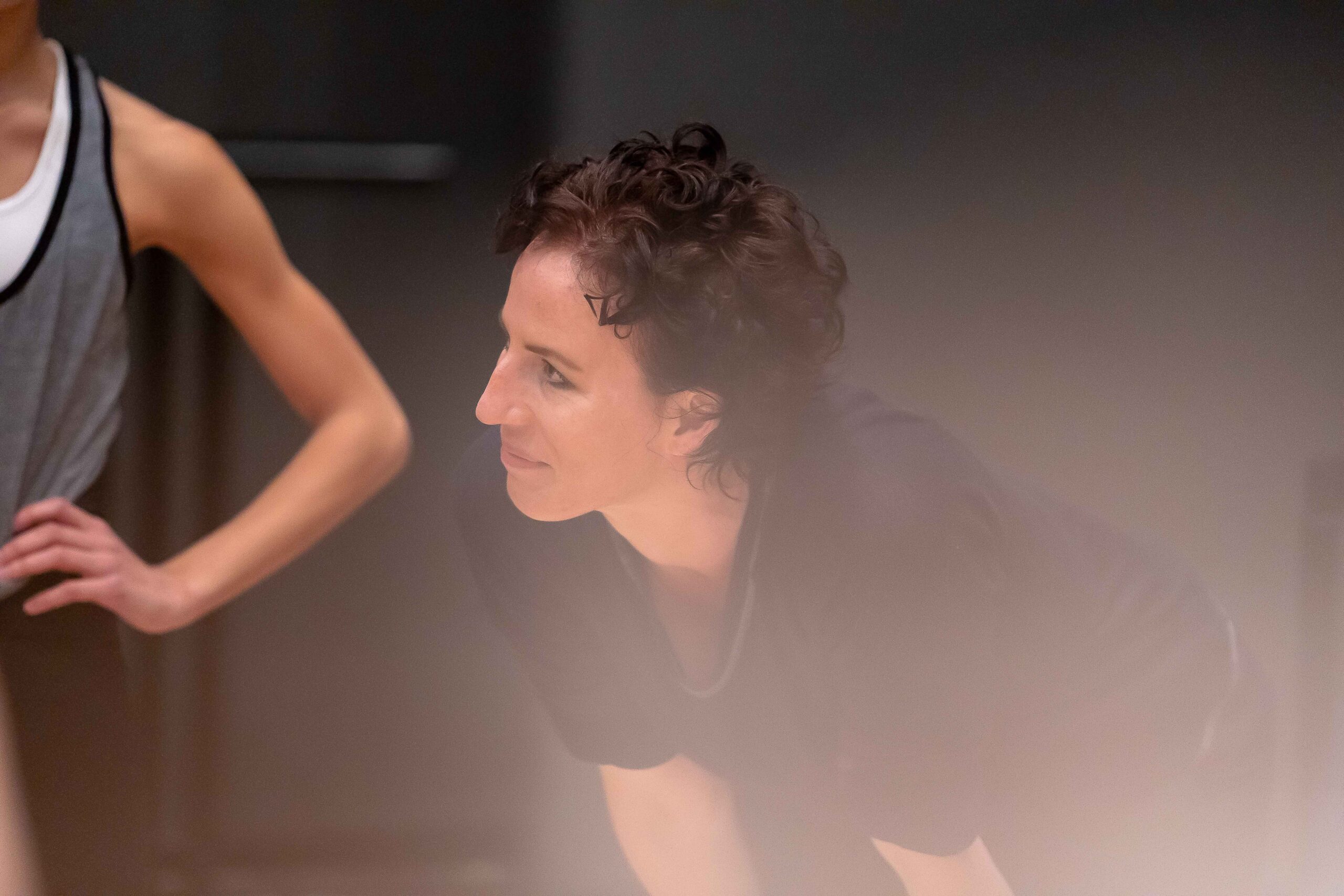
Sarah Hillmer’s latest work notebook is mauve. Or maybe, she says upon reflection, it’s a light purple/lavender mix. Hillmer is very particular about her notebooks. Each ballet she has worked on as a rehearsal director, stager or assistant to the choreographer — and there have been dozens — warrants a notebook of a different color. Each one is a lined composition book from Walmart or Target. The mauve one is for Crime and Punishment, choreographer Helen Pickett’s new full-length ballet for American Ballet Theatre. It is a flurry of diagrams, arrows and numbers, all crucial information about the ballet’s structure, movement and characters.
Hillmer spent two weeks in May and three in September in American Ballet Theatre’s historic New York studios as assistant to Pickett, an award-winning choreographer who has created more than 60 ballets for stage and film in Canada, Europe, Australia and the United States, including four for Atlanta Ballet when she was the company’s choreographer in residence.

It wasn’t Hillmer’s only job this year. She is well-known in the Atlanta dance community as founder and director of ImmerseATL, a training and mentorship program for movement artists; executive director of the contemporary dance company staibdance; and business operations manager for Windmill Arts, a performance space in East Point, Georgia.
In New York, she spent six to eight hours each day working closely with Pickett and Ballet Theatre Rehearsal Director Nancy Raffa. She listened, observed and took notes (always in pen, she says — never pencil), coordinated with other members of the team, demonstrated movement phrases for the dancers and managed the chaos of directing large group sections. “I say this with love, but it’s backbreaking work,” she said recently at a coffee shop in Decatur, the small Atlanta-adjacent city where she lives.
Crime and Punishment is based on Fyodor Dostoyevsky’s 1866 novel about an impoverished student who believes some people are exempt from the law as long as they act for the greater good. With this in mind, he murders three people, including an unscrupulous pawnbroker, but becomes tortured by guilt and confesses to the crimes. Pickett has taken the story out of 19th century Russia and created a streamlined psychological thriller. The ballet will premiere at New York’s David H. Koch Theater October 30 through November 3.
Susan Jaffe, Ballet Theatre’s artistic director and one of the few women in that role, commissioned the ballet, and Pickett assembled an impressive team: Co-director James Bonas; British TV and film composer Isobel Waller-Bridge; set and costume designer Soutra Gilmour; storied lighting designer Jennifer Tipton (who just turned 87); and videographer Tal Yarden.
With a cast of 39 dancers, Crime and Punishment is the largest work Pickett has created so far, including Lady Macbeth, which she choreographed for the Dutch National Ballet earlier this year, again with Hillmer as her assistant. “We have this symbiotic relationship,” Pickett says of Hillmer. “We know each other so well that she can preemptively see the question I will ask.”
For Crime and Punishment, Pickett created individual stories for each of the 28 corps dancers who populate the busy bar scenes. One of Hillmer’s responsibilities was to ensure each of them knew their character and where they had to be when. “I am good with managing chaos,” she says. “I make sure we are all moving in the same direction (artistically), and I can see when a dancer doesn’t have clarity. That’s when I will unabashedly take over the room.”
This was Hillmer’s first experience working with American Ballet Theatre, and she admits she was nervous initially about coaching some of its most celebrated dancers, among them principals Cassandra Trenary and Herman Cornejo. But once she was in the studio, the nerves evaporated.

“This is what I know how to do,” she says, “communicate with artists. And I know how Helen works. She’s not linear. I can be linear for her. I watch movement pour out of her body. I translate that to the dancers’ bodies. We discover together the intention of the movement. She gives me so much freedom to create with her in the studio, and there is a lot of play and respect between us. Trust and joy and fun.”
Hillmer’s notebook methods reflect her work ethic — organized, precise and detail-oriented yet open to change and discourse. Those qualities were especially in demand during Crime and Punishment rehearsals: Because of a knee injury, Pickett was wearing a brace, limiting her ability to move and making Hillmer’s role of demonstrating movement more important than usual. “Sarah is so valuable and quite extraordinary,” Pickett says. “An exemplary human being. I trust her implicitly.”
The creation process is raw, Hillmer says, because it involves many different elements, not the least of which is character development. “You are always driving down to find a specific intention. When a dancer comes into the studio with opinions on how they would interpret rage, for instance, it adds to the dialogue.” She appreciates Pickett’s emphasis on human-based gesture, as opposed to ballet’s traditional, formulaic mime, and coaches the dancers accordingly.
Hillmer admits to being both in love with risk and shy but has learned to speak up. “You have to keep your senses open to the whole room and make sure the whole team is moving forward with you,” she says. “My work as a rehearsal director gave me this skill set.”
Unusually tall and broad for a ballet dancer, Hillmer started her career at Atlanta Ballet but performed only briefly with the company before transitioning to work as an instructor and rehearsal director for more than 15 ballets, including Pickett’s first full-length ballet Camino Real, Ohad Naharin’s Minus 16 and Twyla Tharp’s The Princess and the Goblin. She built her career step by step by saying yes to many opportunities, particularly those with Pickett, and admits she never would have made it to American Ballet Theatre as a performer. “My body and the way I moved — I didn’t fit the mold. I was the odd girl out.” Her offstage talents gave her a different kind of entrance. “There’s something really profound about this unique journey,” she says. “It’s not the cookie-cutter mold.”
During the 12 years she and Pickett have worked together, their relationship has flourished and deepened. Hillmer is now the only person entrusted to stage the choreographer’s works after their initial run, on companies such as Boston Ballet, Pittsburgh Ballet Theatre and Alberta Ballet in Canada.
“Helen is a huge champion of people. She has been instrumental in shaping my path, and her extraordinary impact on my life as a mentor, artist and creator cannot be overstated,” she says. “It’s so special to be able to make art with someone you respect, who believes in you fully and is a true friend.”
Hillmer often doesn’t see the ballets she works on performed. But this time she will. She will fly to New York on November 2 to see Crime and Punishment before it closes the following day.

Gillian Anne Renault is ArtsATL’s senior editor for music and dance and has been an ArtsATL contributor since 2012. She has covered dance for the Los Angeles Daily News, Herald Examiner and Ballet News and on radio stations such as KCRW, the NPR affiliate in Santa Monica, California. Many years ago, she was awarded an NEA fellowship to attend American Dance Festival’s Dance Criticism program.
STAY UP TO DATE ON ALL THINGS ArtsATL
Subscribe to our free weekly e-newsletter.

PLEASE SUPPORT ARTSATL
Your Gift Sustains the Coverage You Count On!
Related Posts