Review: Atlanta Ballet charms, dazzles in Balanchine’s ‘Coppélia’
More than 100 years after the 1870 premiere of Coppélia, George Balanchine and Alexandra Danilova re-created the ballet for 20th century audiences, infusing it with theatrical charm and modern dynamism.
The production became one of New York City Ballet’s most popular works, and dance critic Arlene Croce wrote of the 1974 premiere that Balanchine’s divertissement-filled third act alone would extend the ballet’s life for another 100 years.
Fifty years hence, is Coppélia relevant enough to last another 50 years? Atlanta Ballet’s company premiere last weekend at the Cobb Energy Performing Arts Centre offered reasons why it might prevail and reasons why it might not.

Lavish scenery and costumes by Roberta Guidi di Bagno set the stage last Sunday afternoon, while Ari Pelto conducted the Atlanta Ballet Orchestra in a lively rendition of Léo Delibes’ score.
There are causes for the ballet’s staying power. It’s a delightful example of how Balanchine’s musical facility, mastery of formal composition and attention to detail vivified plot and characters.
This was evident in the way Coppélia merged dance and mime to forward storytelling, and how each step, like a chord in a symphony, revealed a new facet of the whole conception.
It was apparent in Airi Igarashi’s opening solo as Swanhilda, where the vivacious young heroine explained her predicament to the audience: Her boyfriend, Frantz, was infatuated with Coppélia, a girl who seemed to ignore Swanhilda from her high perch on a balcony — though Coppélia was actually just a mechanical doll.
Balanchine’s touch was palpable in the vitality among Swanhilda’s friends, who asserted the music’s rollicking impetus in every swift step and buoyant line.
The second act, set in the workshop of the eccentric old Dr. Coppélius (Denys Nedak), brimmed with humorous details. The characters’ tiptoeing steps, advancing and hesitating, echoed cartoons. In a charming sequence, Swanhilda’s eight friends amplified her shaking knees like a Greek chorus and helped her to get a grip on her trembling.
Among other colorful details, a bug dropped out of Dr. Coppélius’ seldom-used potion cup and he stamped on it. When the old man wheeled Coppélia (a hastily disguised Swanhilda) from her curtained alcove to center stage, he missed evidence of deception: She held her book upside down.

Throughout the scene, Igarashi was a master of doll-like stylization — both in the way she moved her limbs with stiff mechanical precision even as she seemed to come alive and in the way she let Nedak support her as she dropped at the waist and recovered with a tiny bob before halting, motionless, head inclined to the right.
The third act, a pure-dance celebration, was a showcase on many levels. An enchanting corps of 24 young students in pastel rose tutus comported themselves beautifully. Four jesterellas added to the pageantry, and tiara-clad soloists danced by turns as Dawn, Prayer and Spinner.
Mayu Nakayama, in silvery blue, captured Balanchinian magic as Prayer. She seemed to float like gossamer across the floor, suspending in soft arabesques, her arms elongating upward and outward as every motion emanated expressiveness.
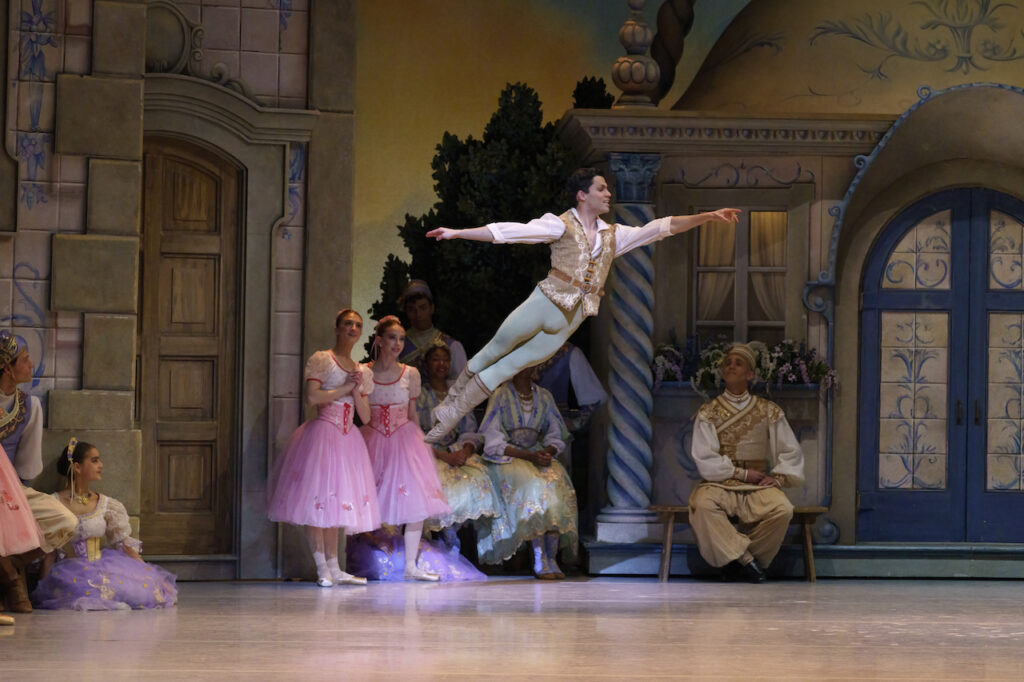
In the heroic interlude “Discord and War,” Marius Morawski modeled the spot-on speed and elevation that his corps of men came close to achieving.
In the ballet’s culmination, a dizzying virtuoso pas de deux, Igarashi showed that she has reached new heights in her powers as a ballerina. Her steadfast partner, Ángel Ramírez, is relatively new to principal roles. Technically strong, with a pleasantly fresh stage presence, he appears on the verge of a breakthrough. In their adagio, the couple created a sense of quiet enchantment in the theater.
Later, in a series of alternating solos, Ramirez tossed off soaring cabrioles with unassuming pleasure. Igarashi dazzled when she sped through dizzying turns en manège, then whirled to a stop, opening her arms generously to the audience like an offering.
The ensemble joined their coda, which was replete with turning leaps and a jaw-dropping fish dive, as children swirled onto the stage for a smashing finale.
There were times when scenery, built for a larger stage, encroached on danceable space, stifling the expansiveness of ensemble dances. Nonetheless, Coppélia is a true crowd-pleaser, great for engaging new audiences and a beautiful addition to Atlanta Ballet’s repertoire.
This lavish confection may last another 50 years if ballet companies in general, and dancers as individuals, continue to invest in understanding Balanchine. It’s an extroverted style that succeeds when dancers fill the steps with a largeness of spirit — there’s a gutsiness, a no-holds-barred risk-taking, a fearlessness. Technical perfection is only the beginning.
In today’s technology-driven world, Coppélia also harks back to a simpler, more innocent time. So again, will it last? As a slice of nostalgia, with comedy, pageantry, lyrical storytelling and supremely musical choreography, there’s little doubt that it will.
::

Cynthia Bond Perry has covered dance for ArtsATL since the website was founded in 2009. One of the most respected dance writers in the Southeast, she also contributes to Dance Magazine, Dance International, The Atlanta Journal-Constitution and Atlanta Magazine. She has an MFA in narrative media writing from the University of Georgia.
STAY UP TO DATE ON ALL THINGS ArtsATL
Subscribe to our free weekly e-newsletter.

PLEASE SUPPORT ARTSATL
Your Gift Sustains the Coverage You Count On!
Related Posts