Review: Dance Canvas’ 2025 Performance Series: Fresh takes on AI, identity
Angela Harris, executive artistic director of Dance Canvas, has supported dance in Atlanta through thick and thin.
Last weekend’s annual 2025 Performance Series, presented at Georgia State University’s Rialto Center for the Arts, was a reminder of the drop in contemporary dance presentations in Atlanta during the past few years. The Rialto, once a hub for top-level professional contemporary dance, offered only one such group last season. Georgia Tech’s Ferst Center for the Arts has taken a similar path, and Atlanta Ballet has turned toward a more classical center.
Dance Canvas is one of several local organizations that is helping to fill the gap. As it has done for the past 16 years, the organization fosters growth of emerging choreographers in Atlanta and other cities with taste and originality, enriching the local dance community and developing programs to support emerging choreographers. Three of the seven choreographers in this year’s showcase came from other cities. In the wake of dance touring cuts, this kind of programming helps to meet needs for artistic cross-pollination.
This year’s Career Choreography Development Initiative included a film series and a live production featuring works in different styles and genres. A frequent theme found among the live works, presented at varying levels of mastery, was different ways in which technology has infiltrated every aspect of our lives. A video of the choreographer’s statement of intent preceded each work.

Schrödinger’s Cat, choreographer Alexandra Light’s highly polished and thoughtfully conceived contemporary pas de deux, was an evening standout. Light, a principal dancer with Texas Ballet Theater, developed the work last summer at the inaugural Jacob’s Pillow ChoreoTech Lab.
The duet in three sections explored the tension between imposed structure and free will. It sprang from Erwin Schrödinger’s thought experiment concerning quantum superposition: If you put a cat in a box with a device that could cause it to die, there’s a moment before opening the box when the cat is both alive and dead.
This paradox led Light to collaborate with ChatGPT to make choreographic choices. For the first section — let’s say Schrödinger’s cat is dead — Light fed ballet steps to ChatGPT and then let AI choose how to configure them. In her introductory video, Light described the second section as “a liminal space where AI and human movement intertwine.” The third section, when the cat is alive, was choreographed almost entirely from human impulses.
The first section unspooled with AI-generated logic. Odd sequences and inorganic transitions recalled how Merce Cunningham used chance methods as freeing devices that revealed new and unexpected movement possibilities.
Dancers AvaRose Dillon and Henry Winn spun in high pirouettes, then dropped to the floor and reached toward one another, their hands seeming to vibrate with the buzz of electricity. This highly inventive section had the unsettling nature of AI poetry, begging the question whispered in Aleyna Brown’s score, “What is life, anyway?”
A sense of dancers’ emotions and natural momentum emerged in the second and third sections, and a flute trill gained strength. Cradling lifts and elongated arabesques revealed a human essence defined by trust. For the ending, AI chose between two possible outcomes: On Friday, the couple embraced each other, a conclusion that satisfied both logic and feeling while raising questions about how AI may shape our future.
The evening’s remaining works showcased a diverse array of developing voices.
Van Banks’ Closet Case opened the program. Its large set piece, a clothing rack that spanned the stage space, enclosed its six dancers in a metaphorical closet. Six dancers began individual solos and moved through different groupings and re-groupings. Sometimes confrontational and at other times marked by weight sharing and mutual support, they suggested conversations about identity and acceptance, and the shedding of protective layers of personae. (Disclosure: Four of the dancers are Perry’s former students from the Kennesaw State University Department of Dance.)
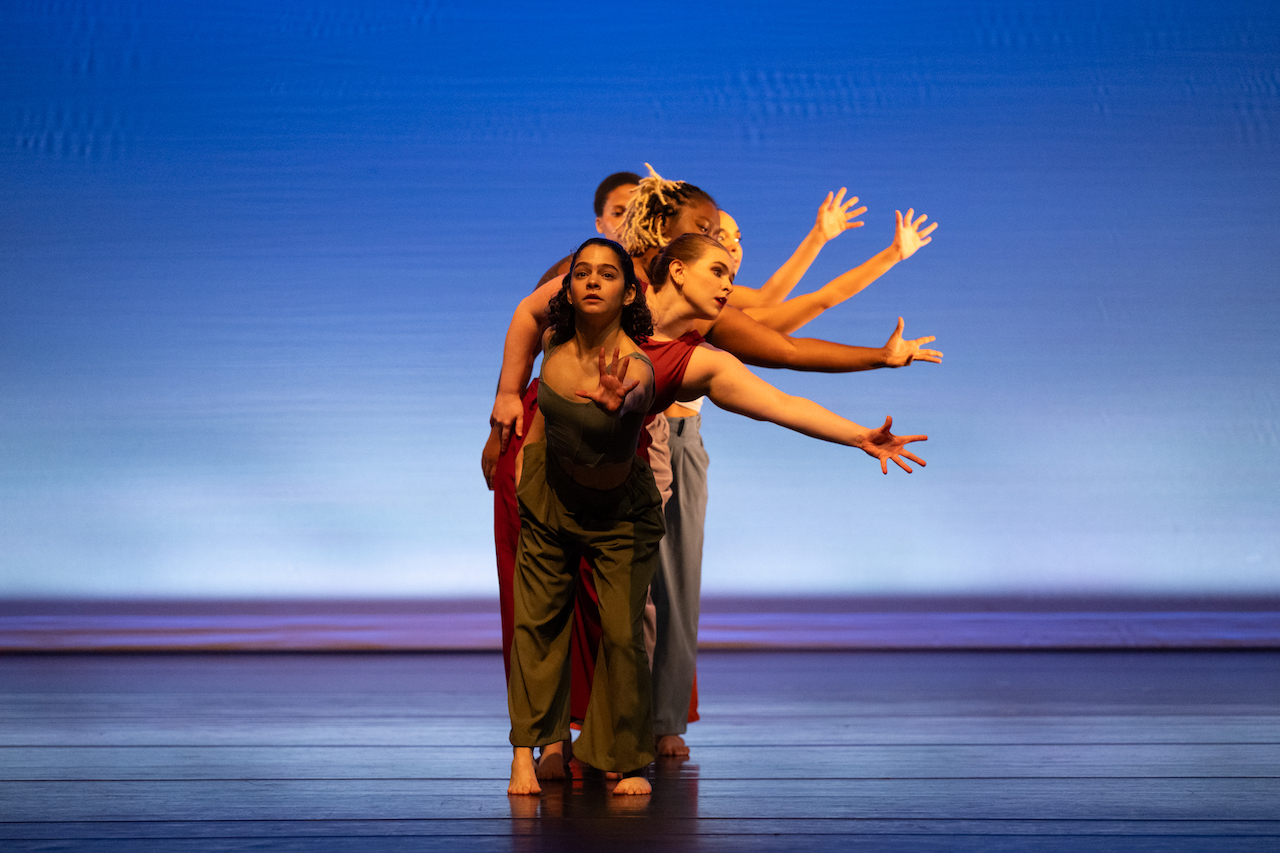
In vibrant tones of coral, indigo and violet, Meaghan Novoa’s Fractal created a world of kaleidoscopic geometries inspired by the 60s vibe of Howie Wonder’s psychedelic optical illusions. Dancers repeated variations on a simple gesture: an arm extending to the side; elbows and wrist bent at similar angles; palm facing upward. The resulting multiplicity of movements, from exploding symmetries to spiraling bursts, created a delightful sense of wonder and whimsy.

Bubble tents in Versaille Jones’ The Dishwasher served as machines that connected people’s minds.
Maryland-based choreographer Erica Rae Smith’s Veneration: Honor, Remember, Celebrate sought empowerment through ancestral connection. In the opening procession, four female dancers emerged in sleek ivory garments with grass-skirt pieces attached at the waist. Ankle rattles accented each step with otherworldly sound as their hips and shoulders swayed with timeless power and dignity.
As music shifted from traditional African rhythms to Nikki Giovanni’s earth-encompassing poetry to contemporary Afro beats, Smith’s blend of modern dance, jazz, African dance and Jamaican dance hall styles challenged dancers while celebrating an ancestral tradition’s depth and breadth.
With striking visuals, Versaille Jones’ The Dishwasher played with a duality that’s increasingly relevant in a tech-filled world: whether to seek convenience or to take on struggles that bring about personal growth. Five female dancers, in suits of black and gleaming silver metallic, moved in and out of two 10-foot wide transparent bubble tents, presumably protected insular spaces of convenience.
One of the evening’s most innovative and captivating works, the piece explored a wide range of human relationships, with movement and score by turns frenetic, driving and mechanistic.
Sevon Wright’s Sense Senses was a lush exploration of movement through the five senses. Wright extended her presentation to the Rialto lobby, where scents, flavors and a mural could be sampled. Wright’s well-crafted trio created an immersive effect through vibrant colors and dancers’ tactile sense of abandon, inviting audience members to share the pleasure of their circular motions and serpentine undulations.
Tethered, by Philadelphia-based choreographer Jameel Hendricks, was marked by screens worn in front of the dancers’ faces, which served both as masks and modes of communication. The ensemble, including the luminous Atlanta native Song Tucker, moved through Hendricks’ appealing blend of street and contemporary dance: Initially, they hobbled, hands held tightly at the hips, then opened into sweeping circular motions, arms and legs carving wide circles, and dove into spiral turns that accelerated into tight pirouettes for a finale that was ultimately life-affirming and beautiful.
::
Cynthia Bond Perry has covered dance for ArtsATL since the website was founded in 2009. One of the most respected dance writers in the Southeast, she also contributes to Dance Magazine, Dance International, Atlanta Magazine and The Atlanta Journal-Constitution. She has an MFA in narrative media writing from the University of Georgia.
STAY UP TO DATE ON ALL THINGS ArtsATL
Subscribe to our free weekly e-newsletter.

PLEASE SUPPORT ARTSATL
Your Gift Sustains the Coverage You Count On!
Related Posts