Review: Horizon’s “House” doesn’t blow roof but welcomes conversation
The House That Will Not Stand explores racism and misogyny through the eyes of Black women living in French colonial New Orleans. Written by Marcus Gardley, directed by Thomas W. Jones II and on stage at Horizon Theatre through August 6, this play gives its audience moments to laugh, cry and gasp as women struggle to navigate a fast-changing cultural landscape. The result is not a fully polished piece, but it hits enough high notes to let the story soar.
House is the story of Beatrice Albans, a free woman of color living in New Orleans in the wake of the Louisiana Purchase. It is the day before the United States officially takes control of the territory, which will result in a sharp decrease in rights even for free people of color. Beatrice hopes that the recent passing away of her White husband, Lazar, will secure her well-being once his will is read, but there is one problem — she is not actually his wife. She is his placée, a sort of “left-hand bride.” This arrangement was common in French colonial New Orleans and was the most common form of relationship between White men and women of color. Placées enjoyed the rights of free women, but, with new U.S. rule on the horizon, Beatrice’s status is in danger of being eclipsed by her late husband’s legal wife.
There’s also another problem: Some think Beatrice was the one who killed Lazar. We learn as much in the opening scene through a visit from Beatrice’s friend-turned-enemy, Madame LaVeuve (Latarsha Rose). LaVeuve needles Beatrice about the local gossip while feigning concern for Beatrice and Lazar’s daughters, Agnes (Margaret Ivey), Odette (Tequilla Whitfield) and Maude Lynn (Kenedi Deal), whose name is definitely a pun. The young ladies have been forced by Beatrice to put their mourning for their father on public display, despite their varying levels of indifference toward his death. Only Maude Lynn is genuinely bereaved, though her anguish is mostly just Christian piety.
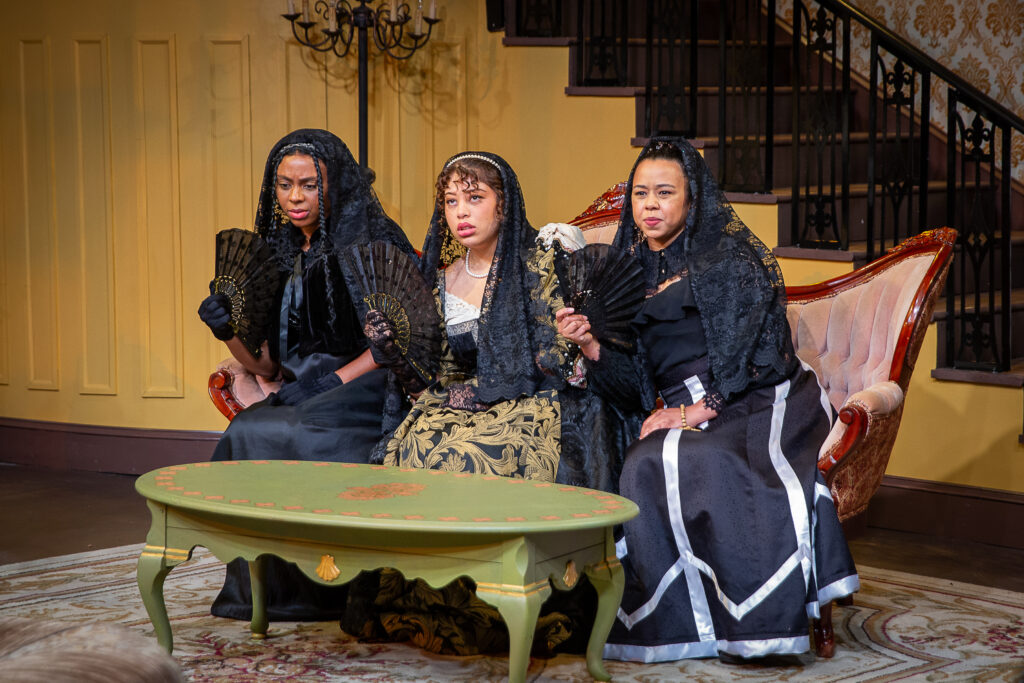
The cast has some standout performances, particularly from Donna Biscoe as Beatrice and Alia Shakira as Makeda, the Albans family’s house slave who spends most of the play trying to secure her freedom. Biscoe fully embodies Beatrice, and her sneering retorts are one of the most consistently enjoyable things in the show. It’s Shakira, however, who is the heart and soul of this play, delivering some of the most emotional moments and serving as the perfect counterbalance for the sharp-tongued Albans family.
And while each of Beatrice’s three daughters finds levels of comedy and drama in her character, the juiciest moments go to Whitfield as Odette, who triumphantly claims the most laugh-out-loud sequence in the show. Let’s just say she is having an absolute ball in her role. Latarsha Rose is also a versatile player, pulling double duty as Madame LaVeuve and Maria Josephine, Beatrice’s “crazy” sister whom she keeps locked in the attic.
Of course, this is New Orleans we are talking about, so the play does dip its toe into the supernatural with allusions to voodoo and repeated implications that Lazar’s ghost may be haunting the house. This affords lighting designer Mary Parker plenty of opportunities to play around with eerie mood lighting and atmospheric flashes of thunder that evoke an oncoming storm, both the literal one and the metaphorical one.
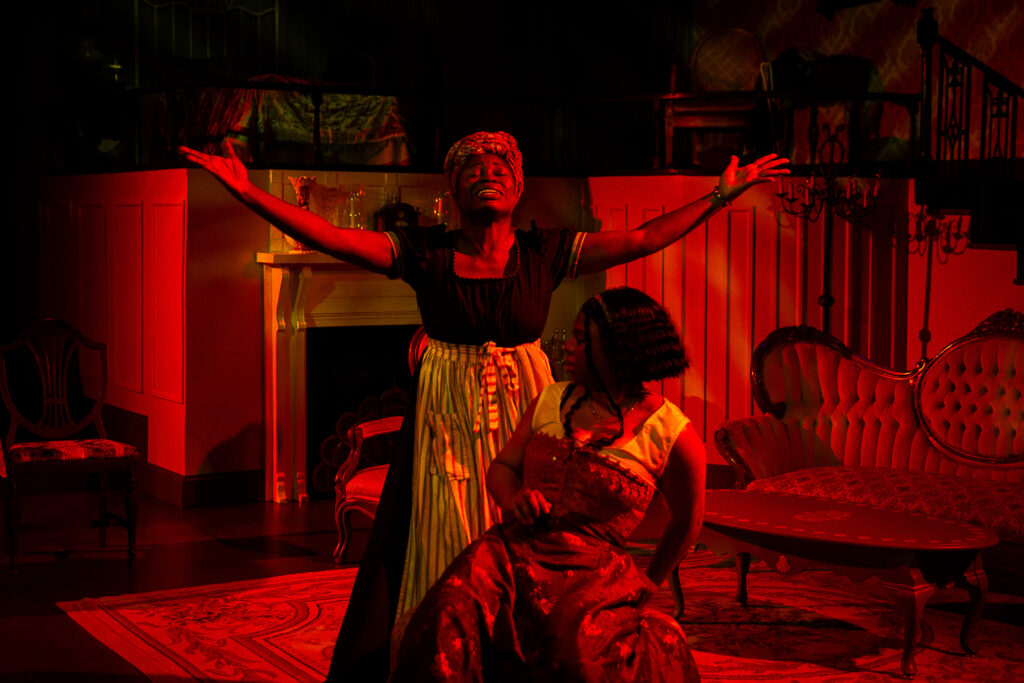
The whole piece benefits from a sense of atmosphere, from Dr. L. Nyrobi Moss’ gorgeous costumes to Tyehimba Shabazz’ thrilling sound design. It’s not so much a New Orleans swagger, though, as an otherworldly apprehension. The dialect work is all over the place, with some actors attempting a Louisiana drawl while others thinking better of it, and the few words of French in the script sound awkward coming out of the very Georgian actors. Still, some of House’s most impactful moments come from embracing the fantastical or allowing time and space to blur, bringing the French influences of Creole culture into conversation with the characters’ African roots.
Gardley’s premise is dramatically rich, exploring how women of color struggle to assert themselves in a world where their freedom is only given at the behest of powerful men. While this production eventually finds that richness, it takes until halfway through the first act for all of the elements to settle. The play honors the history of Black enslavement and the beauty and suffering from which Black culture emerges. The rest of the time, the play is funny and fairly compelling, but in brief moments it touches something more magical. Go for those moments, and take the rest of it as you will.
::
Luke Evans is an Atlanta-based writer, critic and dramaturg. He covers theater for ArtsATL and Broadway World Atlanta and has worked with theaters such as the Alliance, Actor’s Express, Out Front Theatre and Woodstock Arts. He’s a graduate of Oglethorpe University, where he earned his bachelor’s degree, and the University of Houston, where he earned his master’s.
STAY UP TO DATE ON ALL THINGS ArtsATL
Subscribe to our free weekly e-newsletter.

PLEASE SUPPORT ARTSATL
Your Gift Sustains the Coverage You Count On!
Related Posts