Review: In “Good Bad People,” binary thinking on racial violence is blown to bits
In the wake of the Black Lives Matter movement, it’s easy to forget that the wrongful death of another Black person is not always met with protests, marches, scathing op-eds and roof-rattling cries for justice. All of those things are important and necessary. But Good Bad People — on stage through March 12 at True Colors Theatre — reminds us that with each bullet fired, a mother is locking herself in her room and weeping. A father is flying to Vegas to drown his grief in booze. Friends and family members are sifting through belongings, trying to make sense of what has happened. One life ends and others are upended.
Written by Rachel Lynett, Good Bad People opens during the aftermath of the death of Amiri Johnson, a 23-year old Black man living in Los Angeles who was shot by a police officer while taking out the trash. His sister June (Veanna Black) returns home to help her family and finds that her father has disappeared, her mother, Miriam (Terry Henry), is refusing to leave her bedroom, and her sister Audre (Asia Rogers) is doing everything in her power to control public perceptions of Amiri’s death. Old resentments begin to boil over as the three women attempt, in very different ways, to negotiate their private grief against the public outrage that Amiri’s death has sparked.
Lynett takes a measured approach in introducing us to the Johnson family. The specifics of their relationships with each other and with Amiri are unveiled in layers, activating the audience’s curiosity without being overtly expository. The individual family dynamics are clearly delineated by the actors, who toss each other knowing glances and loaded gestures that hint at a larger family history we are not yet privy to.
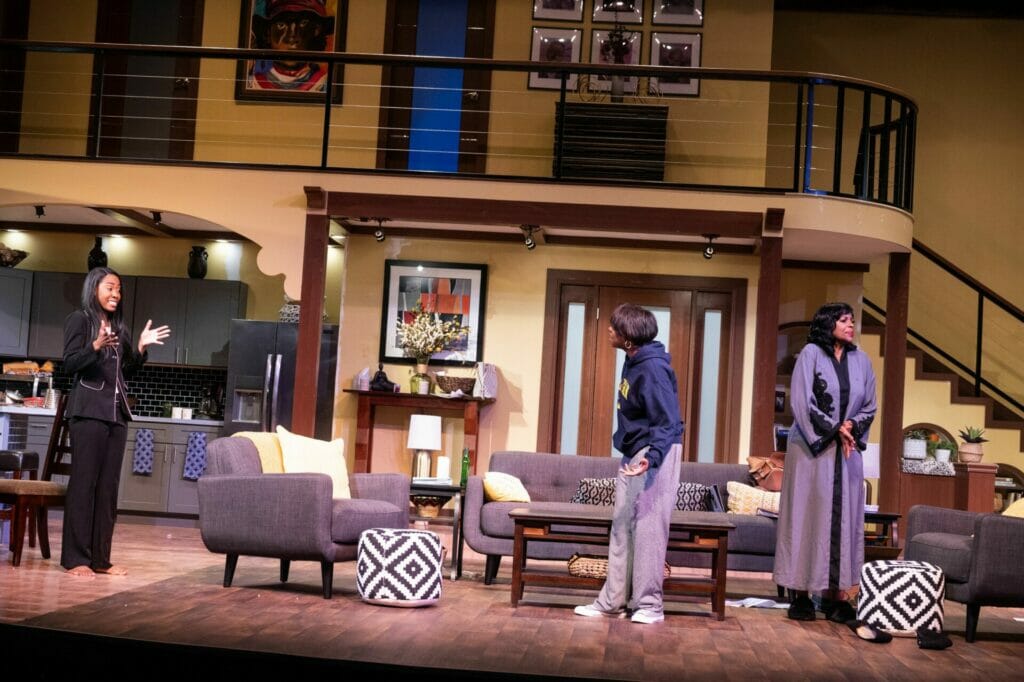
These relationships turn out to be critical to the play’s exploration of grief and violence, as June, Audre and Miriam’s drastically different responses to Amiri’s death create barriers to them being able to mourn together. June wants to do nothing but talk about Amiri and commemorate his life. Miriam, an affluent professor of law who has spent her life building walls to protect herself and her family from the racial violence that she saw growing up, is rattled by the realization that all of her wealth and education could not shield her son from becoming another name in the headlines. Audre, the put-together fiancee of a white politician with presidential aspirations, funnels all of her heartbreak into doing damage control as reporters circle the house looking for statements from Amiri’s family.
Things come to a head when a hasty word from June to a reporter leads to the Johnsons being criticized in the media for being too “respectable” to publicly acknowledge Amiri’s death as an act of police violence. This incident raises the question of what the responsibility of the family is to decry their loved one’s death, even as they struggle to cope with their personal grief. Can we really expect someone to be politically active right after their son or brother has been killed? How long is long enough to grieve before you begin marching?
The performance also argues against the mentality that Black people have to be upstanding, well-behaved citizens in order for their deaths to be worthy of outrage. As Miriam caustically declares: “The only Black lives that have ever mattered are the good ones.” In refusing to paint Amiri as a “good person,” Lynett refuses to compromise one ounce of his humanity. Yes, he engaged in less-than-legal activities. He drank, he smoked weed, and he barely graduated from high school. Still, he did not deserve to be shot. When a well-intentioned but sorely misguided reporter insists that the family presents a sanitized version of Amiri’s life that makes him more sympathetic to her readers, the idea is met with nothing but indignation.
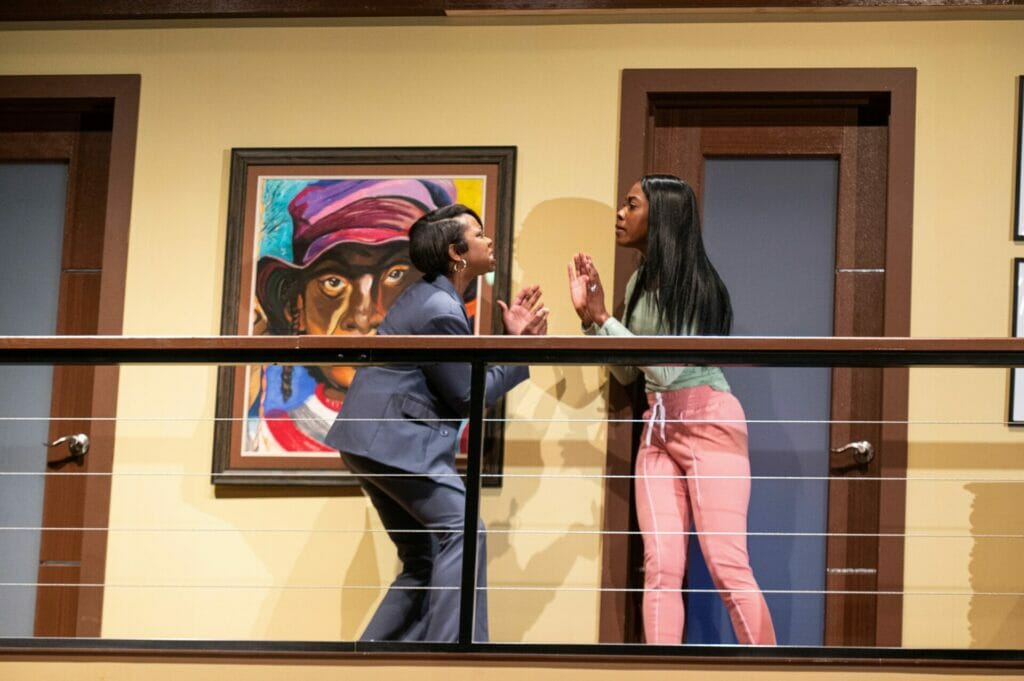
This theme balances well with the first, although it is not always clear which one Lynett is more interested in focusing on. Regardless, both are delivered with an honesty that has as much to do with the talent of the performers as it does with the quality of the writing. Veanna Black is delightfully playful as June, yet brings a startling intensity to June’s darker moments. Terry Henry brings an imperiousness to Miriam, radiating dignity even as her character is drowning in grief. Asia Rogers skillfully conveys Audre’s crumbling composure as she desperately tries to cling to some feeling of control. Annie Jacob and Kylie Gray Mask are strong supporting players as Amiri’s girlfriend and a dogmatic reporter, respectively.
The design work is similarly appealing. The Johnson home, designed by Moriah and Isabel Curley-Clay, makes for a dynamic space for the actors, and several small but eye-catching details help to create a sense of place (the inclusion of palm trees situated behind the various exits is an appreciated touch, creating the illusion that the story environment extends beyond the stage). The lighting design by André C. Allen is another standout, particularly toward the end of Act I, when June’s rage manifests in a stage bathed in haunting red light. The costumes are mostly simple, but designer Jarrod Barnes does an excellent job giving each character a distinctive style, hinting at each one’s mental state.
While Lynett does not sacrifice in terms of the emotional honesty of the piece, she does mix the darker elements with some comedic relief, which alleviates tension in some places. Character dynamics are further fleshed out by allowing the actors to play off of each other in lighthearted ways. Black and Henry are comedic standouts, with Black affecting an off-the-cuff, crude humor while Henry serves up acerbic wit. Their talents tie the piece together, resulting in a well-balanced, hard-hitting, thematically resonant and genuinely funny play that asks us to sit with the gravity of Black lives lost.
::
Luke Evans is an Atlanta-based writer, critic and dramaturg. He covers theater for ArtsATL and Broadway World Atlanta and has worked with theaters such as the Alliance, Actor’s Express, Out Front Theatre and Woodstock Arts. He’s a graduate of Oglethorpe University, where he earned his bachelor’s degree, and the University of Houston, where he earned his master’s.
STAY UP TO DATE ON ALL THINGS ArtsATL
Subscribe to our free weekly e-newsletter.

PLEASE SUPPORT ARTSATL
Your Gift Sustains the Coverage You Count On!
Related Posts