Review: Kit Modus creates polished, engaging synthesis of live music and dance
Kit Modus’ premiere of Figment on Thursday transformed the Callanwolde Fine Arts Center with dance and live music. Attending the dance company’s performances at Callanwolde is always an event, one that simultaneously evokes the Fox Theatre’s old-world glamour and the edgy intimacy of a venue like the black box at the Windmill Arts Center. Thursday’s tour de force performance was no exception. Figment kept the audience rapt with attention throughout and drew an enthusiastic standing ovation.
Figment is founder and artistic director Jillian Mitchell’s first evening-length work for the company and it invites the audience to watch dance as they would listen to music or view an abstract expressionist painting. The performers comprised eight dancers, elegantly clad in black and wearing black socks, and a musical quintet of two cellists and two violinists, led by composer Philip G Anderson at the piano. The dancers filled the ballroom with movement in much the same way the musicians filled it with Anderson’s score. Together, musicians and dancers generated a rich sensorium of effects and images. They explored how creative processes can transcend the differences of aesthetics, mode and medium that separate dance from music, or the visual from the performing arts.

Figment opened with an empty stage and the musical ensemble in a tight group on one side. Anderson’s composition began with plucking of the cellos and violins. While the audience focused on the musicians, the dancers silently entered the ballroom at stage right.
As the last vibrations of the musical introduction faded, the dancers took their positions, evenly spacing themselves into three lines. For several moments, they were still. Viewed against the pale gray Marley floor and the blank white walls of the room, they resembled notes carefully marked on a musical staff, or words on a page.
Almost as soon as it emerged, however, the metaphorical relationship between music and dance, and between dance and other art forms, began to shift and change.
Recorded sounds of rushing air and murmured commentary broke the silence. Then Anderson transgressed the border segregating musicians from dancers by entering the dancers’ space. As he and the dancers began to interact, the stage morphed into a dynamic embodiment of the composer’s interior mental state. Notes came alive and combined into music that seamlessly evolved into dance. Mitchell’s choreography, carefully matched to the rhythm and chromatic scale of Anderson’s score, reminded the audience of how similar are the physical processes through which music and dance are perceived.
Insights about the creative process and the nature of art repeatedly emerged, with sectional transitions often initiated by subtle and clever visual metaphors. For example, at one point a group of dancers stood a long narrow bench on end so Emma Morris could hang suspended between the top two legs. Curling, twisting and folding in on herself, Morris called to mind both a chrysalis and the squirming clefs that mark the beginning of a piece of sheet music. Morris then joined the ensemble and, combining gestures from earlier in the piece with new vocabulary, the dancers demonstrated how a finished work contains — even as it may attempt to hide — all the messiness of its creation.
Figment fused dance, music and spoken word into a cohesive whole that demanded a great deal from everyone involved. Mitchell’s choreography required the dancers to construct a skimming performance of ease from an intricate assemblage of steps and gestures; for the most part, they met that challenge admirably. The dancers rarely left the stage, however, and without an intermission, by the final quarter of the 60-plus minute work, they were showing fatigue.
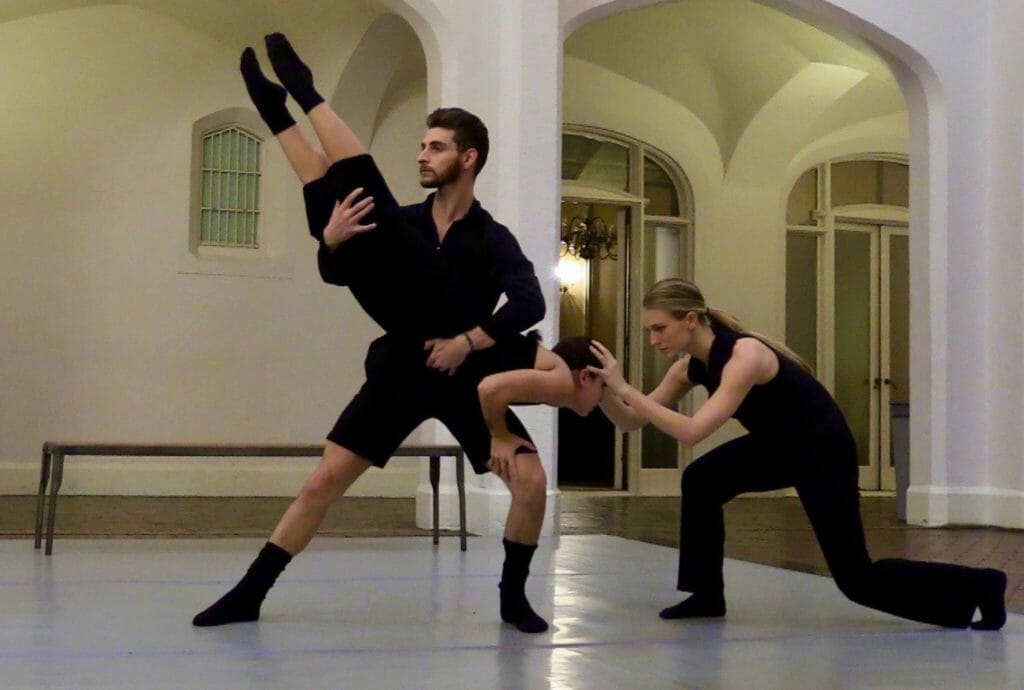
That fatigue compromised an otherwise promising pas de deux between Morris and Jacob Attaway. Sequences involving the full ensemble began to lose some of the crisp timing necessary to make a clear visual distinction between complete synchrony and quick cannon propagation of movement. Figment has enough depth and breadth of choreographic material to support an even larger ensemble, which could mitigate dancers’ fatigue.
Morris and Attaway gave standout performances overall, and Shawny Evans and Maia Charanis were also exceptionally strong. Mitchell created a number of beautiful partnering sequences and moments of contact for Evans and Attaway, who executed them with brilliance and tenderness. Occasional awkward transitions in some of the other partnering sections, however, showed that Mitchell seems to still be working through how to fuse balletic adagio with modern contact work.
Kit Modus and Mitchell first presented Figment as a work-in-progress in 2019. The completed work Thursday showed both company and choreographer successfully maturing out of the emerging-artist stage. Kit Modus leveraged Atlanta’s significant dance and music talent for Figment with Callanwolde’s unique qualities as a performance venue, offering a polished and deeply engaging audience experience. Callanwolde already has a well-deserved reputation as a creative space for visual artists working in and around Atlanta. Thursday’s performance revealed how its partnership with Kit Modus has the potential to raise Callanwolde’s profile as a center for the performing arts as well.
::
Robin Wharton studied dance at the School of American Ballet and the Pacific Northwest Ballet School. As an undergraduate at Tulane University in New Orleans, she was a member of the Newcomb Dance Company. She holds a Bachelor of Arts in English from Tulane, and a law degree and Ph.D. in English from the University of Georgia.
STAY UP TO DATE ON ALL THINGS ArtsATL
Subscribe to our free weekly e-newsletter.

PLEASE SUPPORT ARTSATL
Your Gift Sustains the Coverage You Count On!
Related Posts