Review: “Oh, To Be Pure Again” creates equal space for rage and hope
The 21st century has seen a massive shift in how the American public relates to Christianity, with various studies showing that fewer millennials and Gen Z’ers openly identify as Christian than previous generations, meaning that we, as a culture, are beginning to more openly question the role religion plays in our lives.
This impulse is inherent in Kira Rockwell’s world premiere play, Oh, To Be Pure Again, which runs from March 4 through 26 at Actor’s Express. What is interesting about Rockwell’s work is not only that it explicitly highlights the detrimental effects of purity culture in organized religion, but that it does so while maintaining a nuanced relationship with the Christian doctrine, showing both the benefits of spirituality and faith and the dangers of rigid adherence to tradition.
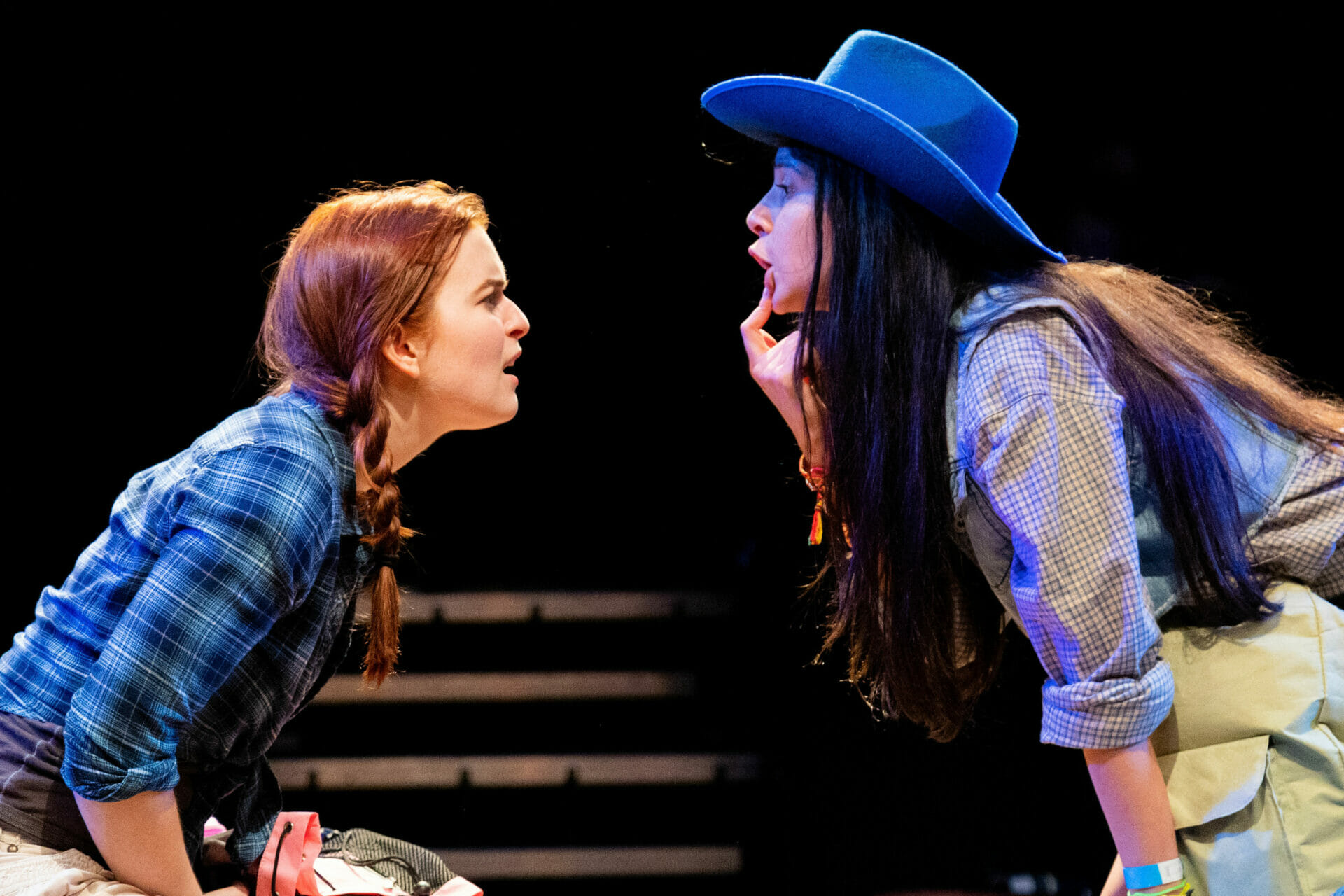
The play takes place at a charismatic church camp in Texas, where campers are instilled with traditional ideas surrounding topics like sex, intimacy, marriage and the role of women in the church. The majority of the plot focuses on a single group of girls, each with different relationships to their faith, who are led by their camp counselor, Becca (Shannon Murphy).
The theme of purity culture is established very early on, with Becca struggling with her sexual desire for her fiance, Adrian (Andres Figueroa). While Becca’s faith is important to her, she is struggling with the way Christianity has taught her to view her body, and this theme is threaded throughout the play with each of the other girls in Becca’s charge.
Jean Ruby (Erin North) is struggling with feelings of shame and guilt after having premarital sex with her ex-boyfriend. Rachel (Aliya Kraar) claims to be fasting, but uses her faith to cover up some deep-seated anxieties. Luna (Brandy Bell), the only girl in the cabin whose family just recently converted, does not yet know how she wants to integrate religion into her life. Autumn (Alejandra Ruiz) rejects the contrived purity metaphors pushed by the church leaders but is unsure how to negotiate her spiritual beliefs with her more rebellious tendencies. Trina (Ebony Jerry), an ambitious athlete, is conflicted over how her drive to succeed may conflict with the expectations of the church.

The actors are all excellent in their own ways, but Shannon Murphy is a standout. Her performance as Becca is layered and compelling, held together by a kind of anxious charisma. She has a palpable sense of connection with the other actors, framing Becca as a mentor figure who strives to help her girls, while doing her best to cope with her own insecurities.
This sense of camaraderie is prevalent throughout the play and helps to center the major themes of female friendship and support. She and Figueroa also have exceptional chemistry, drawing us into the world of the characters from the very beginning.
The script is wonderfully understated, choosing to let certain things speak for themselves. Many issues are touched on without explicitly being named, and there are hints at deeper traumas that many of these girls do not openly discuss. However, one does not get the impression that Rockwell is trying to hide these issues, but rather that she is content to let them speak through the silence. This tactic makes it all the more interesting to see which issues she chooses to address tacitly and which she calls out screaming.
One thing that Rockwell confronts head-on is the role of the patriarchy in religion, and how biblical ideals are often centered around men, to the detriment of women. In a particularly fascinating scene, Luna — who has been raised by a single mother for most of her life — struggles to connect with the idea of God as a loving father, as she has no model for what that love feels like. Instead, she chooses to address God as a mother, a subversion that later gets expanded during the play’s climax in ways that unambiguously reveal how a male-centric Christian theology becomes inherently oppressive to women.
Rather than throw the baby out with the bathwater, however, Rockwell maintains a balanced perspective on religion, lifting up the aspects of spirituality that bring these women comfort and strength while denouncing the repressive structures of organized religion. Many of the symbols and iconography of the church are inverted or reframed in such a way to emphasize their potential for empowerment, including a final tableau that is as evocative as it is subversive.

Rockwell’s subtle touch extends to the confessional scenes that are used to give us glimpses of the inner worlds of the campers. Several issues are alluded to without being obviously underlined, and there is a level of authenticity that comes from the characters addressing their confessions to God, rather than to the audience. These scenes are also augmented by Toni Sterling’s expressive lighting, complete with warm red lights shining beneath the floorboards signifying what could be an innocent campfire or the flames of hell.
Stephanie Busing’s set design combines well with Nick Battaglia’s decorations to create an immersive environment that enhances the immediacy of the action. Kate Hoang also contributes with the sound design, which relies on generating the kind of ambient noises which are ever present at an outdoor summer camp.
Perhaps what is most remarkable about Oh, To Be Pure Again is the way it creates equal space for both rage and hope. The characters are increasingly frustrated with the shame that is constantly being weaponized against them, and that rage starts to boil over by the end, but Rockwell insists that there is still room to be optimistic. Perhaps by redefining their relationships to their own bodies, these women may redefine their relationships with religion as well.
::
Luke Evans is an Atlanta-based writer, critic and dramaturg. He covers theater for ArtsATL and Broadway World Atlanta and has worked with theaters such as the Alliance, Actor’s Express, Out Front Theatre and Woodstock Arts. He’s a graduate of Oglethorpe University, where he earned his bachelor’s degree, and the University of Houston, where he earned his master’s.
STAY UP TO DATE ON ALL THINGS ArtsATL
Subscribe to our free weekly e-newsletter.

PLEASE SUPPORT ARTSATL
Your Gift Sustains the Coverage You Count On!
Related Posts