Review: Strong Monica Hogan Danceworks program presents fresh perspectives
In an interview with ArtsATL last year, Monica Hogan Thysell said the two- to three-year plan for her company, Monica Hogan Danceworks, includes introducing the company’s dancers and Atlanta audiences to different choreographic styles and perspectives. This season, Thysell, who relocated the company to Atlanta in 2021 after eight years in New York, revealed the next step in that plan: launching an initiative to support new and emerging Atlanta-based dance makers.
Last Sunday at the Emory Performing Arts Studio, Thysell and company presented four works from participating choreographers, along with Thysell’s latest premiere. Titled spectra: volume 1, it was a strong program that featured some emotionally resonant moments, promising range from the emerging choreographers — Julianna Feracota, McKaylah Bristow, Dom Kinsey and Meaghan Novoa — and exciting, expressive performances from several company members and guest artists.

Feracota’s From Within and Kinsey’s Nostalgia: What is? delivered particularly well on Thysell’s promise of fresh perspectives and innovative movement vocabularies.
From Within, a reworking of a 2018 solo, opened the show. Feracota began center-stage, back toward the audience.
As she flapped her arms frenetically up and down, she alternated between bending her elbows sharply and almost touching her hands to her shoulders and extending her arms so that her hands slapped her hips and thighs on the downward swing. The sharply-defined muscles in her back moved almost like piano strings, limned against the dark backdrop and above her long black skirt by strong directional lighting.
As a percussive beat joined the ambient drone of the music, Feracota left off what looked like a desperate attempt at flight. Turning to face the audience, she twined her skirt around her arms and neck. Then it became a binding at her wrists and then a noose.
Shifting again, her movements explored the ways in which arms are as unlike legs as they are unlike wings. Folding forward at the waist to put her palms against the ground, she tested walking on hands and feet while the stark lighting again brought her musculature into sharp relief.
Finally, she recycled the movement, keeping the same gestures but changing the impulse and intent by releasing tension, redistributing weight and smoothing out transitions. The ambient music rippled into a recognizable melody, harmony and rhythm. Frantic flapping settled into lovely upper body work; her costume transformed from a hindrance into a prop. She abandoned mimicry for metaphor, letting meaning emanate from her body, rather than imposing meaning upon it.
Kinsey’s Nostalgia: What is? sent an ensemble of eight guest artists on a journey through time and memory. The dancers, dressed in white, flowed across the stage through athletic sequences that included jumps and floor work, flocking like birds from one seemingly spontaneous grouping to the next. A leader would emerge for several moments, only to be subsumed within the crowd and replaced by a new center of attention.
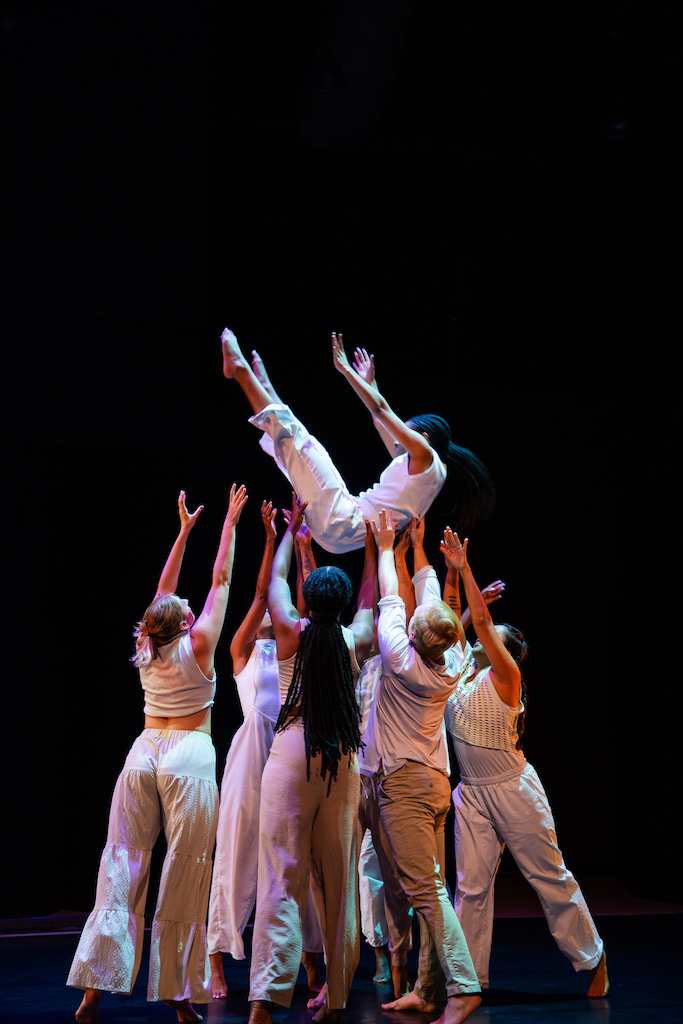
Within the flow, the dancers occasionally snagged or stuck against a particular phrase. The ensemble would grind to a stop, and their reiterative movements, while still synchronized, deconstructed big, fluid motions of whole limbs and torsos into smaller, mechanical tics of individual joints and body parts. Then, one dancer would break free of the inertia, flowing past the obstruction into a new phrase or to a new location on the stage, and the rest would follow.
Throughout, Perlizbeth De Leon and Walter Apps often led the group, and their presence and technical skill drew the eye even when they were part of a collective.
Over the course of the piece, a repeated gesture in which the dancers held and gazed into imagined scrying instruments gained authenticity as the dancers let their bodies feel the weight and their eyes gaze into the depths of the imagined object.
Thysell’s Counterpoint closed the show with a glowing spectacle of colorful surfaces that occasionally parted to reveal moments of tender intimacy and humor. Divided into eight sections, each named after a relationship phase or aspect, Counterpoint’s movement featured slightly turned out feet and opened hips that nodded to ballet and blurred the lines between neoclassical ballet and contemporary dance.
The most striking quality of Thysell’s choreography, however, was the way it seemed to transport the dancers into an alternate plane of lower gravity. Their heads, hands and feet were weighted, but their bodies seemed to fall in slower motion, subject to centrifugal forces that pulled legs and arms taut and hands and feet to the extreme edges of arcs and circles in sweeping kicks and port de bras.
The full company was costumed to accentuate their individuality in a range of saturated jewel tones and soft pastels, and they projected joyful ease through technically challenging phrase work. Aryanna Allen — particularly in her solo, “ii. The Longing,” and a pas de deux with Britanie Leland, “v. The Falling” — stole the show with her grace. In one memorable repeated phrase from “v. The Falling,” Allen and Leland mirrored one another through a series of melting falls that took them from kneeling, through a fetal position and back up to their knees, over and over, until it finally took them offstage.

Similar to those two sections was a duet between Audrey Crabtree and Emily Hogan, “vi. The Argument,” and a trio that included Allen, Feracota and Leland, “vii. The Letting Go.” Each had distinctive emotional and gestural signatures that were reinforced by Thysell’s choice of music and David Reingold’s lighting design.
The other four sections lacked that very clear thematic differentiation. Consequently, Counterpoint‘s narrative structure was ultimately circular or recursive, at odds with the progression or evolution implied by the section titles.
The company’s cohesion and technical accomplishment in Sunday’s performance showcased Thysell’s strengths as a company director. In its second season, this looks like a troupe that has been dancing together for several years. The diversity and strength of the dance artists brought together by Dancework’s emerging choreographer’s initiative demonstrated Thysell’s commitment to Atlanta as the company’s new home.
::
Robin Wharton studied dance at the School of American Ballet and the Pacific Northwest Ballet School. As an undergraduate at Tulane University in New Orleans, she was a member of the Newcomb Dance Company. In addition to a bachelor of arts in English from Tulane, Robin holds a law degree and a Ph.D. in English, both from the University of Georgia.
STAY UP TO DATE ON ALL THINGS ArtsATL
Subscribe to our free weekly e-newsletter.

PLEASE SUPPORT ARTSATL
Your Gift Sustains the Coverage You Count On!
Related Posts