Review: The Ailey Company dazzled with angels, sinners, ‘Grace’
Alvin Ailey American Dance Theater’s 2024-25 season “celebrates the life and legacy of Artistic Director Emerita Judith Jamison,” who passed away in November 2024. “When Mr. Ailey died, I remember Judy telling us that we shouldn’t be sad because look at what he has left us,” recalled Nasha Thomas, national director of AileyCamp and a master teacher for Ailey Arts in Education & Community Programs. “I feel the same way about her.”
During the company’s annual stop at the Fox Theatre in Atlanta, February 12 through February 16, the programming demonstrated what is perhaps Jamison’s most enduring contribution — establishing an environment in which reverence for a shared tradition provides a strong foundation for individual creative expression and personal artistic growth.
The six-performance run featured nine works, only two of which — Revelations, which ends every performance and excerpts from Cry, staged Thursday evening as a special tribute to Jamison — were choreographed by Ailey himself. Four of the remaining seven were new this season.

Lar Lubovitch, a younger contemporary of Ailey who founded Lar Lubovitch Dance Company in 1968, contributed the stunningly gorgeous Many Angels. It ran on the Saturday matinee bill, along with Finding Free, another world premiere, this one by Hope Boykin, and a new production of the 1979 duet Treading, by Elisa Monte.
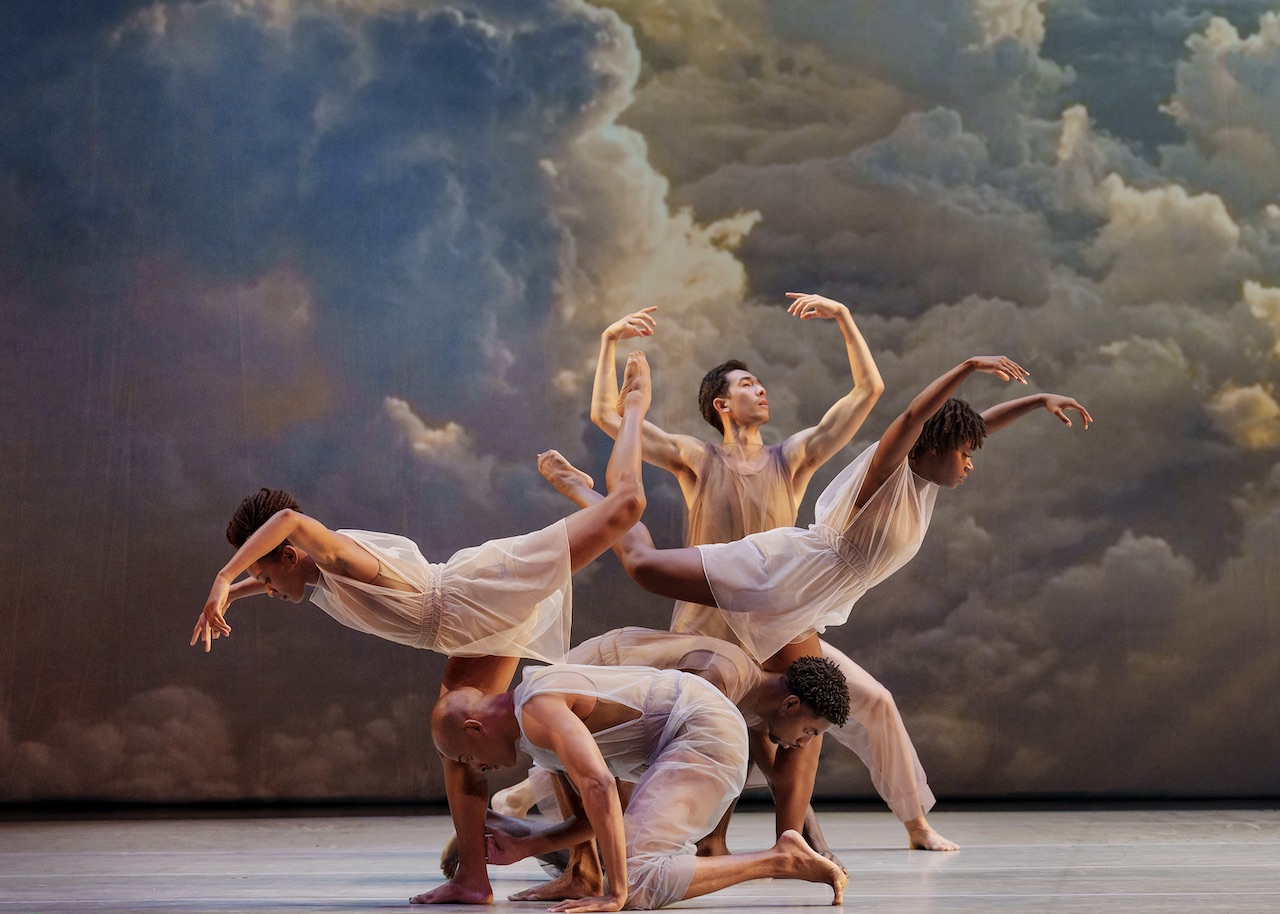
Lubovitch’s scenic design set Many Angels against a sunlit cloudscape that could have been drawn from a detail of Michaelangelo’s depiction of heaven in the Sistine Chapel. Through a trick of perspective, the scale of the backdrop made the five dancers — Jacquelin Harris, Yannick Lebrun, Ashley Kaylynn Green, Isaiah Day and Jesse Obremski — seem larger than life. Clothed in leotards under gauzy chiffon, they were statuesque, monumental. Lubovitch’s choreography to “Adagietto” from Gustav Mahler’s Symphony No. 5 in C-Sharp Minor seamlessly blended the Ailey-Horton vocabulary and neoclassical ballet and showcased the ensemble’s exquisite technical skill and eloquent musicality.
In program notes, Lubovitch wrote that Many Angels was a response to the question, “Why do you make dances?,” which for him is like the famous conundrum of St. Thomas Aquinas: “How many angels can dance on the head of a pin?” The piece is a work of art that in Lubovitch’s words “may exist in the world just for the sake of itself.” Nonetheless, through visual and thematic association, the backdrop for Many Angels called to mind structural counterparts, the red flames in “Sinner Man” and heavy late-afternoon sun in “The Day is Past and Gone” — both sections in Revelations. Lubovitch’s work was both an homage to Ailey and a joyous requiem for Jamison.
Further, Lubovitch crafted this platonic ideal of a dance for a multi-ethnic ensemble who hone their skills learning and performing repertory rooted in the “blood memories” of a Black man born in the Jim Crow South. It was an implicit acknowledgement that Ailey’s company is one of the places where an artist of Lubovitch’s caliber looks to find such perfection in contemporary American dance.

Boykin’s Finding Free opened the Saturday afternoon program, and it was a perfect bookend to complement Revelations. Aesthetically and thematically complex, Finding Free, like Revelations, took the audience on a journey, exploring liberation as a collective and individual undertaking. Occasionally, individuals lead the way, while, at other times, they may lag behind the community — and sometimes the group itself evolves in different directions before, hopefully, re-establishing consensus.
While the stage design was minimal, the ungendered costumes, by Boykin and Jon Taylor, helped carry some of the dance’s narrative weight as they evolved from futurist double-collared and tightly-belted trench coats, through regal capes and tunics and into leotards under loose chiffon kaftans. The ambiguous sartorial references placed the action in past, present and future simultaneously.
Boykin’s choreographic vocabulary was expressive, and with the costumes created a distinctive look and feel for each section. In the first, for example, tight group formations, sidelong glances and the trench coats contributed to an atmosphere of surveillance.
Losing their belts, the trench coats transformed in the next section into cape-like garments over sashed tunics. As their garments loosened, the dancers’ gestures and movements became more expansive as the lines they created with their bodies and the formations they created together opened.
Eventually, everyone lost the outer layer altogether before donning kaftans in the final movement. In the penultimate section, Green danced an emotionally resonant and technically lovely solo as four ropes or chains wrapped about her waist were held by dancers in the wings. While Green appeared to struggle against the restraints, once she was free of them gathered them in her arms and carried them offstage.

In the final section, the collective gaze lost its censorious implications, the group witnessing individual transformation without judgment, even, perhaps, with approbation. Green returned to the stage wearing a double-layer kaftan, subtly different from the single layer worn by everyone else. Finding Free, however, ended with her re-integration into a heterogeneous but harmonious ensemble.
Monte’s Treading testified to her diverse background as a dancer — she was a principal with Martha Graham Dance Company and performed with Lar Lubovitch Dance Company and Pilobolus — as well as her singular vision as a choreographer. Coral Dolphin and James Gilmer were outstanding in the duet, which featured ground-hugging floorwork and gravity defying lifts and weight-sharing, all of it requiring incredible strength and control. The work was sensual, sexy and every bit as impressive now as it must have been when it premiered 45 years ago.
The Saturday matinee was a strong program and featured a particularly inspiring cast in Revelations. The entire ensemble moved as if infused with a single spirit in “I Been ‘Buked” and “Rocka My Soul in the Bosom of Abraham.” Gilmer, once again, and Sarah Daley-Perdomo were transcendent in “Fix Me Jesus,” and De’Anthony Vaughan, Isaiah Day and Patrick Coker pulled out all the stops for “Sinner Man.”
Ailey’s final performance on Sunday afternoon opened with interim Artistic Director Matthew Rushing’s new Sacred Songs, set to updated arrangements of spirituals from the original evening-length Revelations that were cut to bring the iconic work down to its current approximately 30-minute run time. It included some notable and affecting moments of stillness and contemplative grace, such as the final section in which the ensemble knelt beneath blue-tinged lighting as if by a sacred pool, cupping and pouring out water over their hands, arms and heads.
The overall aesthetic, though, was “Revelations meets Broadway.” The musical arrangements were big band jazzy, and the movement blended Ailey-Horton vocabulary with the smooth weightlessness of theatrical jazz. It even featured a “behind the scenes” opening with dancers garbed in studio attire a la A Chorus Line. Danced with technical aplomb, the piece was fun and a treat for the eyes. It did not have the narrative depth or aesthetic impact of Finding Free or Many Angels, however.

The company’s new production of Ronald K. Brown’s 1999 Grace followed Sacred Songs on Sunday. Brown’s choreography was notable at the work’s premiere and now as an excellent example of how social dance forms — such as hip-hop, breaking and vogueing — have informed the evolution of contemporary concert dance. Both casts did a wonderful job, with Dolphin on Thursday and Jaquelin Harris on Sunday looking outstanding in the principal role.
On Thursday evening, Al-Andalus Blues by Jamar Roberts featured another set of ungendered costumes, also designed by Taylor in collaboration with the choreographer: futuristic black unitards with metallic piping. Stage design by Libby Stadstad included an island form at center stage that was slowly dismantled, with the pieces moved upstage over the course of the first section. Roberts drew vocabulary from Ailey-Horton technique and twisting, contralateral lines from flamenco and set them to recordings of “Angelitos Negros,” as performed by Roberta Flack, and Miles Davis’ version of “Concierto de Aranjuez (Adagio).” The piece was short but powerful.
The restaging of excerpts from Cry on Thursday evening were a fitting tribute to Jamison, who was Ailey’s muse for the 1971 work. Harris, Samantha Figgins and Caroline T. Dartey embodied her spirit as they re-embodied her movement. Jamison’s loss is deeply felt within the Ailey organization and the dance world: She left us with so much.
::

Robin Wharton studied dance at the School of American Ballet and the Pacific Northwest Ballet School. As an undergraduate at Tulane University in New Orleans, she was a member of the Newcomb Dance Company. In addition to a bachelor of arts in English from Tulane, Robin holds a law degree and a Ph.D. in English, both from the University of Georgia.
STAY UP TO DATE ON ALL THINGS ArtsATL
Subscribe to our free weekly e-newsletter.

PLEASE SUPPORT ARTSATL
Your Gift Sustains the Coverage You Count On!
Related Posts