Théâtre du Rêve’s “Code Noir” film depicts a timeless fight for justice, equality
Carolyn Cook and her colleagues at Théâtre du Rêve are comfortable presenting their work on stage and in classrooms throughout the year, but this week the company continues to expand its reach by debuting its second film project.
Known for bringing French language and Francophone culture to life on the American stage since 1996, Théâtre du Rêve is making Code Noir: Les Aventures du premier Comte de Monte Cristo (Black Code: The Adventures of the first Count of Monte Cristo) available via streaming through the end of the month.
Its central characters hail from different continents and eras: French General Alexandre Dumas (1762-1806), known for his heroics during the French Revolution (and for being the father of Alexandre Dumas, The Count of Monte Cristo and The Three Musketeers author who shared his name); and Sandrine Boudreaux, a fictionalized modern-day defense attorney. In the film the two meet mysteriously, via a timeslip, in the prison where he was an 18th century political captive, and their time together has a tremendous effect on both of them.
“It’s very Outlander,” Cook jokes.

It was in early 2019 that Cook, as the troupe’s artistic director, presented this as a play. Her journey, though, began a few years earlier as she set out to create a project dealing with the African diaspora. She knew she wanted to work again with actor Thandiwe Thomas DeShazor, with whom she collaborated on Actor’s Express’ 2018 version of Angels in America, but was unsure of the subject.
Cook had some ideas but when a board member told her about the book The Black Count: Glory, Revolution, Betrayal, and the Real Count of Monte Cristo, a biography about General Dumas, Cook read it and knew she had found her central character.
In the original version, the character of Boudreaux was French but here she is from New Orleans. “She is completely disillusioned and broken down by the failures of the judicial system and is ready to retire,” Cook says. “She can’t do it anymore. She has one last case. She gets thrown back in time with this story of a man, Dumas, who — in spite of everything — never ceased to fight for justice and equality and the principles of the French Revolution. It reinvigorates her.”
In addition to writing the script, Cook plays Boudreaux and Napoleon Bonaparte. The cast also includes DeShazor as Dumas and Michelle Taylor Willis as Dumas’ mother. Directed by Lauren Morris, an associate artist at the company, the film had its red-carpet premiere Monday night at Southwest Arts Center, with the cast and crew in attendance. For Cook, it was a memorable evening, especially in that she hadn’t attended a public event of this nature in quite some time.
Recent seasons for Cook — also one of Atlanta’s busiest, most celebrated performers — have largely been about navigating Covid-era programming. In 2020, the company prepared its version of Vive la Fontaine!, a retelling of the fables of Jean de La Fontaine, only to see it run for only seven performances. Although it was a few days away from an official Atlanta shutdown, Cook decided to close after the Sunday performance. She told her actors she would pay them for the length of their contact and then had to deal with two weeks of refunds and, in the case of some supportive school groups, issuing vouchers for future events. Yet the company got through it all.
Later that summer came a “long overdue” Atlanta racial reckoning series of meetings, largely facilitated by and for the theater community. For Cook, the importance of digging into the Franco-African diaspora only seemed to expand. She decided to make her 2020-21 season virtual and take some of the company’s in-home salon events online. However, for her next season, she wanted to return to the project and knew the only sure-fire way to do it was as a film. She did so in conjunction with Hush Harbor Lab, which was founded by Addae Moon and Amina McIntyre and primarily focuses on work by and for Black Atlanta-based artists.
Unlike some stage companies that were seeking to make plays look more cinematic for streaming, it was important to Cook that the filmed version of Code Noir look and feel like a piece of theater.
“It was an artistic and practical choice,” she says. “We are a theater company — I don’t want to pretend to be anything else.”
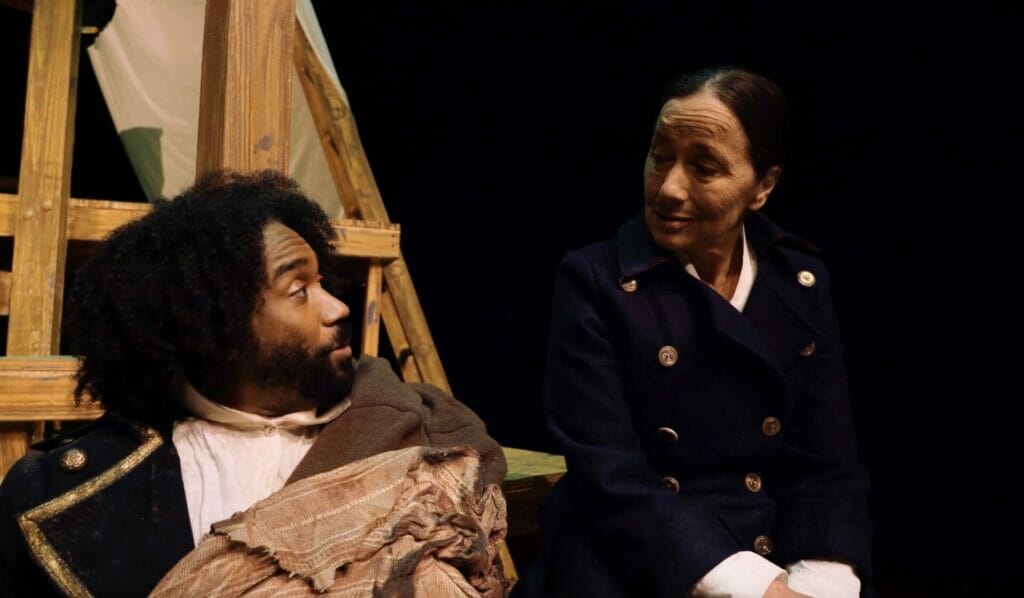
She conferred with Felipe Barral of IGNI Productions, who was taken by her vision and the notion of doing a bilingual feature, and the project was filmed on 7 Stages’ mainstage.
Théâtre du Rêve also produced a smaller-scale film project last year, I Am Not Evangeline, so Cook doesn’t consider Code Noir a one-off. This new element gives the company a deeper arsenal.
“I feel like we have discovered this capacity to create pieces that tell stories that, in the past, our patrons would not have known, and I like having that in our back pocket. As the pandemic shifts to being an endemic, we’ll get back to doing theater, but we have discovered there are other possibilities out there.”
Code Noir can be viewed through March 31 by clicking here. The film is in English and French with subtitles.
::
Jim Farmer covers theater and film for ArtsATL. A graduate of the University of Georgia, he has written about the arts for 30-plus years. Jim is the festival director of Out on Film, Atlanta’s LGBTQ film festival. He lives in Avondale Estates with his husband, Craig, and dog Douglas.
STAY UP TO DATE ON ALL THINGS ArtsATL
Subscribe to our free weekly e-newsletter.

PLEASE SUPPORT ARTSATL
Your Gift Sustains the Coverage You Count On!
Related Posts