Micah Cash shows what the South looks like from a Waffle House window
Art and everyday life intersect in Micah Cash’s photographs at the Georgia Museum of Art, documenting vistas from Waffle House booths across the Southeast.
::
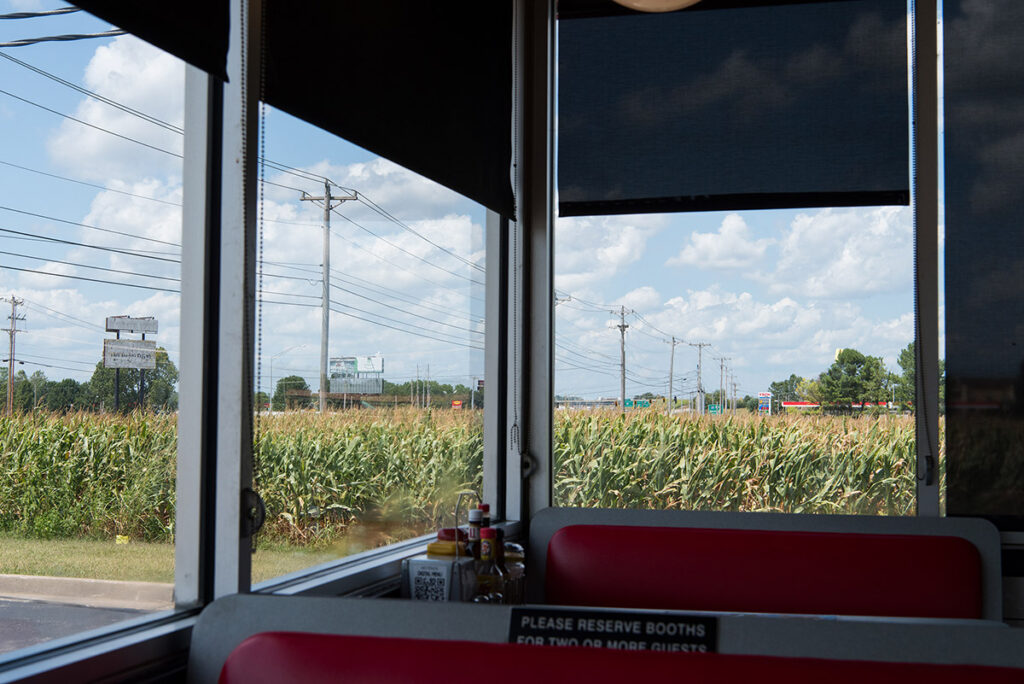
Travel almost anywhere in the South, and it won’t be long before you come across a Waffle House. The restaurant chain, with its broad appeal and singular parlance for ordering hash browns, has become nearly ubiquitous across the region. There are even highway exits with Waffle Houses on both sides. Stopping in is always easy, whichever direction you’re headed.
But could the Waffle House become a lens through which to contemplate the complexity of contemporary American life? That’s the question Charlotte-based photographer Micah Cash began asking in 2018.
“When you’re at a Waffle House, you can pretty much do whatever you want,” says Cash, whose exhibition of photographs Waffle House Vistas opens at the Georgia Museum of Art in Athens on August 24 and runs through June 1, 2025. “That’s one of the many reasons I was attracted to it. Every now and then, someone might ask why I was photographing the parking lot, but, for the most part, people pretty much left me alone.”
Cash’s project started with a straightforward concept: capturing the view from inside various Waffle Houses across the country. “Before I even figured out the conceptual framework for the project, I was posting an image on my Instagram every Friday. I wasn’t saying anything, just ‘Waffle House Vistas’ and the name of the location.”
Cash says the conceptual framework took shape as he would take a seat in a booth, observe and photograph from a fixed vantage point, striving to capture the best composition without moving around. “I would just pick up my camera and make an image where I sat. I tried to get the best composition I could, but part of that was the conceptual framework, to really limit myself, to really see what I was looking at.”

It became clear that the everyday scenes might become a canvas for exploring deeper truths about community, identity and the often-overlooked beauty of ordinary life. The framework highlighted for him the inherent beauty and interest in what might initially appear trivial and mundane. The images are as varied as the locations themselves — ranging from the mundane expanse of strip malls and dollar stores to more striking landscapes.
Cash’s motivation was not merely to document but to delve into the socio-economic and cultural narratives encapsulated within these seemingly ordinary settings. For Cash, whose work often explores the intersections of mundane landscapes and economic realities, Waffle House stands as a uniquely egalitarian beacon. Its unassuming charm, marked by retro globe lights and red leather booths, bridges disparate worlds, seemingly both demarcating and transcending the usual boundaries of social class, race and geography.

Waffle Houses, situated in both affluent and impoverished neighborhoods, serve as a microcosm of the broader societal spectrum. “Waffle House does not care how much you are worth, what you look like, where you are from, what your political beliefs are,” he says. “It creates a sense of belonging unlike most other places. Waffle House is for everyone, but different groups of people perceive it as being for them.”

Cash says he’s been shocked by the overwhelming response. His book, Waffle House Vistas, initially published in 2018, was re-issued with additional images and essays in 2020. It sold out quickly, sparking a wave of personal stories from readers who saw their own lives reflected in the photographs.
“It was tremendous that so many people wanted to sit down in that booth with me and have that conversation about their lives,” Cash recalls. “There were very deep, personal conversations I had with random strangers who reached out over social media or email.”
But why Waffle House? Why the response, and what is that connection that Cash and so many people seem to feel toward the chain?
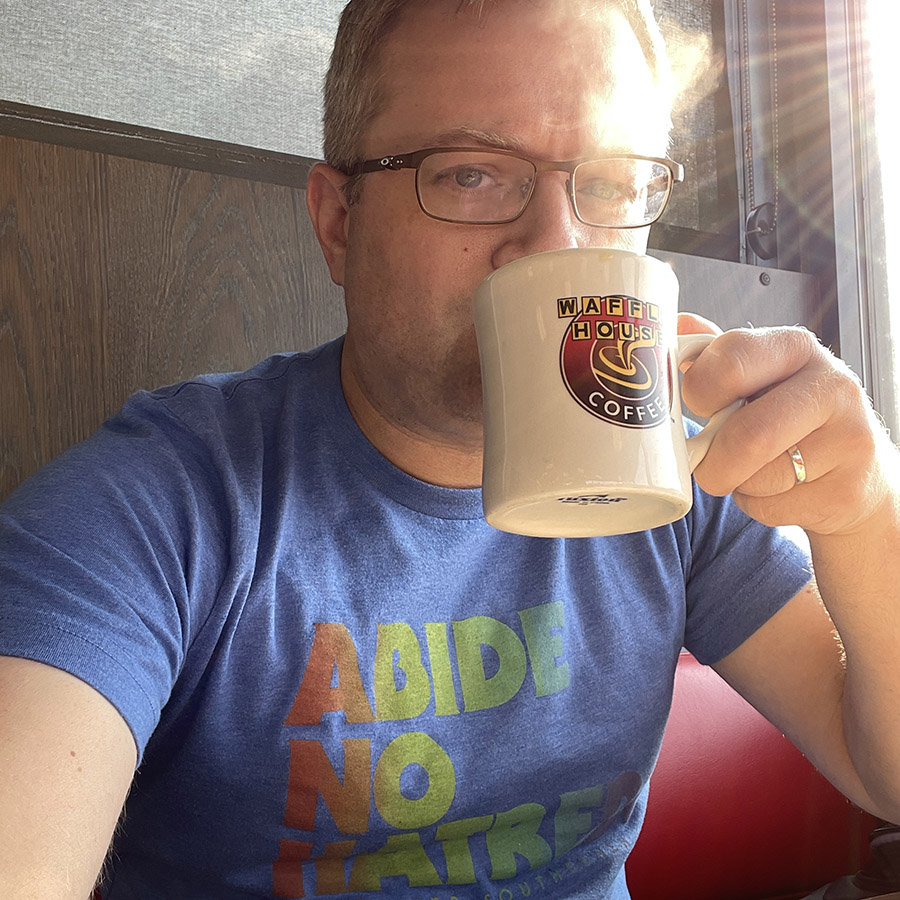
“My answer is never consistent,” he says. “The older I get, the more I experience, the more hypotheses I have. Right now, I think it’s the experience. The experience hasn’t really changed since the 1950s. There have been some updates over the years, but it’s still just a big rectangle with a large griddle in the middle and people calling out orders. There’s something very nostalgic and American about that.
“Other chains try to recapture that in themed, nostalgic ways, but it’s not really nostalgia at Waffle House because it’s been that way for 60 years. There’s nothing inauthentic about a Waffle House. It’s the American roadside diner experience. That’s memorable. I think it makes people feel a part of something.”
::

Andrew Alexander is an Atlanta-based writer.
STAY UP TO DATE ON ALL THINGS ArtsATL
Subscribe to our free weekly e-newsletter.

PLEASE SUPPORT ARTSATL
Your Gift Sustains the Coverage You Count On!
Related Posts