Review: Atlanta Symphony shows Georgia talent with a world premiere
The Atlanta Symphony Orchestra celebrated Georgia talent Thursday evening, with two rising stars running the show. For both musicians, the ASO left a lasting imprint and, to a varying degree, helped shape their music and their careers. One brought his specialty pieces, the sort of music that makes a great first impression. The other brought a world premiere.
On the podium was Jonathon Heyward. An Augusta native, he heard the ASO in Symphony Hall as a kid. Educated in the U.S. and later in the U.K., he speaks today with an English accent. Now based in Britain and Germany, he’s making his debut with orchestras around the world, among the most in-demand conductors of the younger generation. With Beethoven’s all-purpose “Leonore” Overture No. 3 and Shostakovich’s bleakly satirical Symphony No. 9 on the program, he was playing to his abundant strengths.
The other outstanding Georgian was bassist Xavier Dubois Foley, a Marietta native now in his late 20s. His resume looks like a rocket on vertical ascent: A graduate of the ASO’s Talent Development Program — designed to foster diversity with high-level training and support — he attended Philadelphia’s prestigious Curtis Institute of Music and won the 2014 Sphinx Competition. In 2018, he was awarded what’s seen as a sort of coming-of-age Nobel Prize for super-virtuosos, the Avery Fisher Career Grant. Many past winners are now classical celebrities, from violinist Joshua Bell and pianist Yuja Wang to bassist Edgar Meyer, who was one of Foley’s teachers. (Unfortunately, most of the audience was likely unaware of Heyward and Foley’s local connections since there was no mention from the stage or in the program.)
As a composer, Foley’s reputation is also blossoming. The ASO commissioned his Soul Bass for Double Bass and Orchestra and Thursday we heard its world premiere. Apparently the ink was practically still wet when rehearsals began. The concerto was inspired, says the composer, by the popular dance and music TV show Soul Train. Like that iconic 1970s televised dance party, which connected Black artists and culture to a much broader audience, Foley’s Soul Bass aims to introduce “a hybrid blend of African American gospel and R&B music . . . infusing a more traditional classical form of writing with the taste of soul.”
The 20-minute concerto is scored in three contrasting movements. It’s fun but not especially funky. “Prelude” opens with a bold theme and sexy tango rhythms. Hunched over his bass at center stage, Foley enters with the sultry solo part. The whole thing moves. It’s lightly orchestrated, giving a non-too-loud bass instrument plenty of sonic space to be heard. There are snazzy effects, such as a call-and-response section. The soloist sings cha-cha-cha; the orchestra replies with its own cha-cha-cha. When the percussion enters, it’s too much and they’re way too loud — the sort of thing that might be corrected before Saturday’s repeat performance or might require a quick revision to the score before future performances.
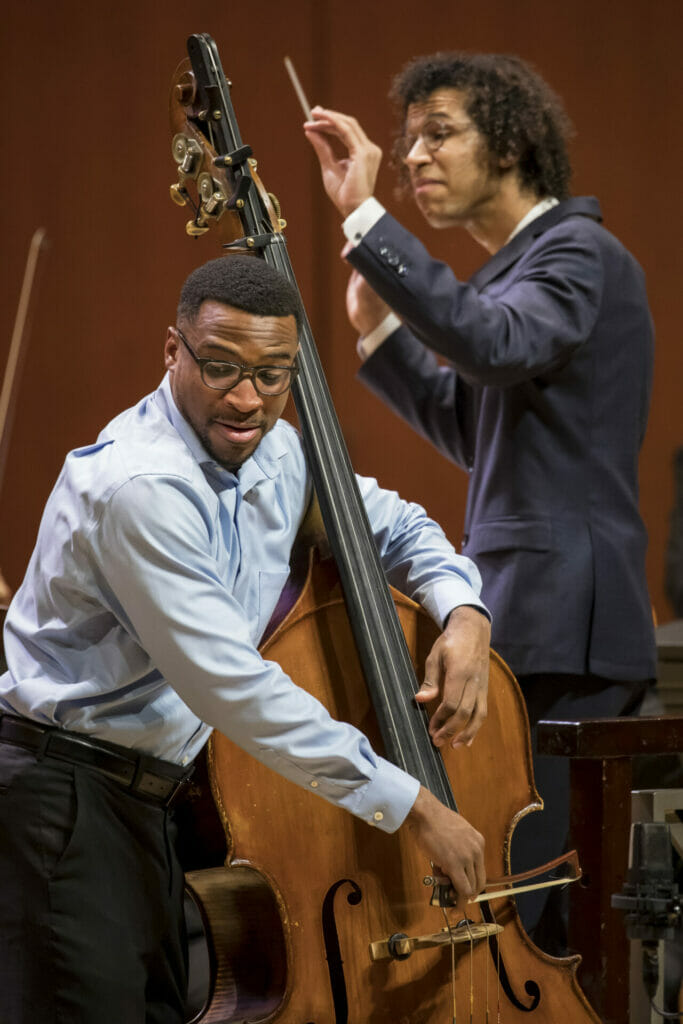
As promised, this first movement is in traditional form, with that fast tango opening, then a lyrical melodic middle, followed by a solo cadenza, leading us back to a recapitulation of the tango opening. Throughout, Foley has the solo bass play at or near the top of its range, its highest and most singable notes. But keeping with tradition, Foley’s cadenza sounded almost improvised, a couple of dazzling minutes that showed off the composer’s cleverness and the instrument’s full range — growling from the low end, zigzagging at top speed up the fingerboard to land on thrilling top notes, like an opera singer at the climax of an aria. Foley’s radiant expressiveness and extreme virtuosity, perfectly in tune, showed a young master at work.
The second movement, marked “Chorus,” begins as a dreamy fairy tale, with magical harp plinks and breathy flutes and clarinets. The bass enters as if in prayer, slow and contemplative, but soon takes a searching, improvisatory feel — two terms that come up often in this concerto. There are moments that have the ring of Americana, of wide open spaces (perhaps a nod to the country-folk aesthetic of his teacher Edgar Meyer?). Just as the dreamy imagery makes a return, the mood darkens but never turns glum. Slashes from the orchestra are played against an emotional and searching solo voice, and the movement ends gently. Questions were asked; none were answered.
The final movement, “Fugue,” was so catchy I heard people humming the main theme in the lobby at intermission. Was he quoting something?
“Fugue” opens with the bass sawing away at big chords and double-stops — where two strings played at once — lumbering left and right at a walking pace. The orchestra enters with a bluesy vibe, but soon those steps turn into a march, made obvious when the snare drum arrives. Throughout, the soloist slides and slips between the lines. Another virtuosic cadenza, an exciting orchestral buildup, and the concerto ends with a flourish and a showy plunk! from the solo bass. Euphoria from the audience.
As a composer, Foley is still finding his way with orchestration and balancing the instrumental sections. The orchestral musicians (and especially the percussionists) at times seemed unclear in their motivations and where their parts fit in the grand scheme of the concerto, which led to some hesitation. Still, Foley the composer is clearly on his way. As a performer, he’s already sensational.
The evening opened with the “Leonore” No. 3, one of several pieces Beethoven wrote as an overture for his only opera, which was eventually renamed “Fidelio.”
Lanky in his crisply tailored blue suit, conductor Heyward is fascinating to watch. Without a baton, he sometimes signaled the orchestra in balletic gestures, sweeping his hands across long arcs or shaping phrases in circular motions, like a potter at the wheel. Elsewhere it looked as if he were holding invisible teacups in each hand, swinging them to keep the beat. It all worked.
His Beethoven at first seemed sensible and cautious, but he was building structure and amassing power. Unlike most debutant ASO conductors, he kept the orchestra appropriately quiet, all the better to really explode as the drama heightens. In a few places he seemed to conduct just ahead of the beat, which is something I don’t think the ASO (or most American orchestras) are used to. For Heyward, it showed the variety of tools at his disposal.
Dmitri Shostakovich’s Symphony No. 9, from 1945, is a curious thing. It’s relatively short — under a half hour — and uses some of the same phrasing and musical imagery of the grand symphonies written just before and years afterward. The coded language in the mature Shostakovich symphonies addresses two audiences: Stalin and his lackeys, and dissenters (private and public) who suffered under Soviet oppression.

The Ninth Symphony is coy about it. Stretch it out a bit, linger in certain spots, and the mildly bitter bits become acid. But play it straight, take every phrase at face value, and the symphony sounds cute and snarky, at times a bit daffy. Heyward mostly took the latter approach, although the dark undercurrents refused to vanish entirely.
Right from the snarky/playful opening, Heyward proved himself a sophisticated interpreter of the Soviet composer’s music. He kept every detail in place, manicured and neatly articulated, and the balances between sections of the orchestra was superb. The conductor offered a solid reading, not so much with fresh or bold musical ideas but able to hold the orchestra together and get everyone to play out and play together. The result was letting Shostakovich make his own case. Musically polished and compelling, we might suspect Heyward was likely once a candidate for the ASO’s music director job.
There are juicy solos for many of the principal players, who did not disappoint. Laura Ardan’s velvet clarinet lines, to open the second movement, were gorgeously expressive, full of angst and uncertainty.
Best of all might have been Andrew Brady’s extended bassoon soliloquy, asking existential questions (in the Sartre sense) as well as “To be or not to be” questions (in the Shakespearean sense), of a life in suspension, paralyzed between fear and action — perhaps reflecting the composer’s own response to Soviet personal and artistic oppression.
Brady, such a great musician, played the long solos tenderly and sympathetically, as if wounded and trapped. Your heart opened to him. With all that’s going on in the world, it was impossible not to connect Brady’s plaintive bassoon cries with the victims in Ukraine, suffering and with an unknown end, under daily threat by a wannabe Stalin.
But Heyward cut off that mood in the finale, and stripped it of any potential political implications. He played up the craziness in those loopy final pages, sounding like circus music for psychotic clowns.
::
Pierre Ruhe was the founding executive director and editor of ArtsATL. He’s been a critic and cultural reporter for the Washington Post, London’s Financial Times and the Atlanta Journal-Constitution, and was director of artistic planning for the Alabama Symphony Orchestra. He is publications director of Early Music America.
STAY UP TO DATE ON ALL THINGS ArtsATL
Subscribe to our free weekly e-newsletter.

PLEASE SUPPORT ARTSATL
Your Gift Sustains the Coverage You Count On!
Related Posts