Strong Atlanta Ballet premieres play with gender roles
On the surface, from a purely visual perspective, the two works on Atlanta Ballet’s final program of the 2023-24 season, Liquid Motion, could hardly have been more different. In their structure, however, Yellow by Brazilian-born Juliano Nuñes and Nighthawks by Atlanta Ballet’s choreographer-in-residence Claudia Schreier demonstrated their creators’ shared willingness to experiment with and even jettison some of the most persistent conventions of neoclassical ballet. Where Yellow was seriously playful, Nighthawks was playfully serious.
Nuñes is currently resident choreographer with Philadelphia Ballet and has created work for Ballet Jazz de Montreal, Ballet West and the Royal Ballet in London, among others. Writing about his 2022 work Interlinked for Birmingham Royal Ballet, The Guardian’s Lyndsey Winship described Nuñes’ choreography as “technically conservative but socially progressive.”
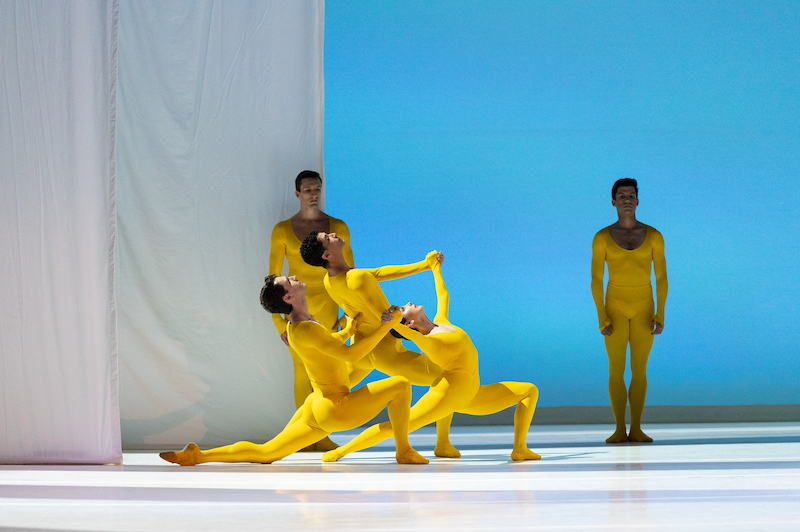
The stage and costume design in Yellow reflected a similar fusion of seeming opposites, joining post-modern maximalist touches with modernist leotard-ballet aesthetics.
For example, the set transformed the dimensionality of the stage with three simple, nested drops of plain white silk. The wings were shallowest downstage and deepest upstage.
As a result, the dance, set to a recording of Beethoven’s Piano Sonata No. 29 in B flat performed by Claudio Arrau, seemed to unfurl within a square tunnel, rather than against a flat screen or canvas.
The ensemble of 16 dancers wore plain unitards in deep, warm saffron yellow. Over the course of Yellow’s approximately 20 minutes, Ben Rawson’s lighting design took the backdrop from white through a series of contrasting hues — hot magenta, cool cyan, soul-soothing lavender.
In the introductory video played before curtain, Nuñes said the work is an exploration of the “realm of connections,” the comings and goings, pairings and partings that make up a life. The costumes and lighting transformed the dancers into flames, flickering into and out of the performance space, flaring into a conflagration together and then scattering like sparks.
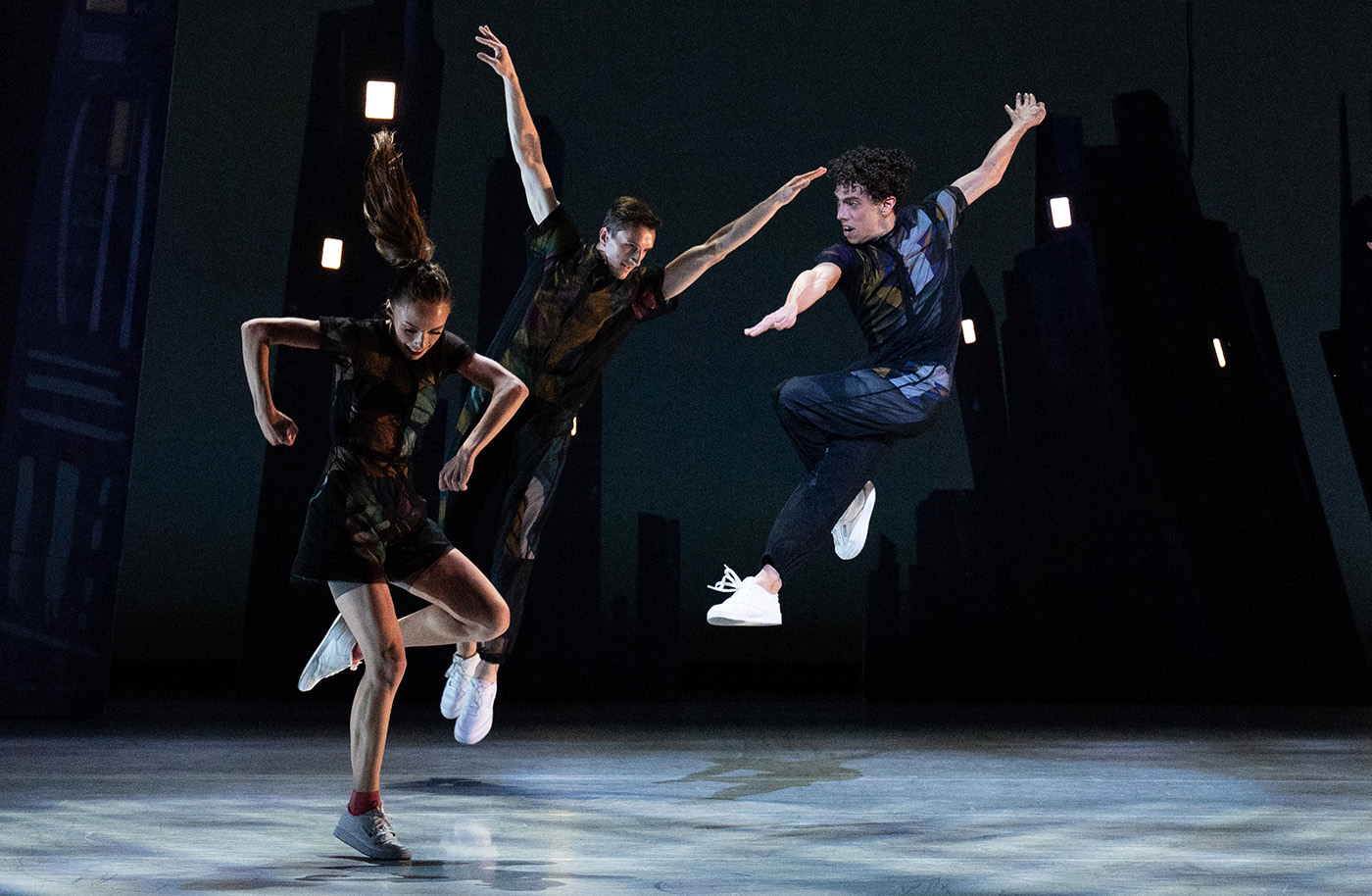
Where Yellow tested the constraints of neoclassical minimalism with its visual aesthetics, the design team for Nighthawks pretty much maxed out the expressive potential of clean lines and smooth surfaces.
As in Schreier’s beautiful 2021 work for Atlanta Ballet, Pleiades Dances, the dancers’ bodies in Nighthawks offered a canvas for visual art, in this instance details from paintings commissioned from Atlanta-based muralist and tattoo artist Charity Hamidullah during the creative process for Nighthawks.
Further, like the costumes from last year’s Carnivale, which were also designed by Schreier’s frequent collaborator, Abigail Dupree-Polston, the T-shirts and jogging pants and sleek tops and shorts for Nighthawks reflected a playful nostalgia. They recalled popular street fashion of the late 1990s and early 2000s; think couture track suits and Vivienne Tam’s culturally and politically significant screen prints.
With the scenes and colors of the city imprinted on their bodies, the 12 dancers in Nighthawks, together with the musical score — recorded excerpts from The Jungle by Wynton Marsalis — brought to life episodes of urban life.
They were framed by Dave Smith’s evocative but spare set. He used the same perspective technique deployed in Yellow — also frequently seen in the elaborate sets for classical story ballets. On each side of the stage, abstracted skyscrapers, with lit windows, created an illusion of greater depth, calling to mind the architecture-lined vistas of New York’s cityscape.
Both Nighthawks and Yellow broke with convention regarding the dancers’ footwear. As a general rule, and in contrast to classical ballets, the female dancers in neoclassical ballet all wear the same shoes. A nomenclature has even evolved to distinguish a “slipper ballet” from a “sneaker ballet” or a “pointe shoe ballet.”

Schreier’s flaunting of the rules in Nighthawks was the more flagrant but ultimately less transgressive. In the first of two main pas de deux, the woman’s partner slips off her white tennis shoes. He then gives her a pair of pointe shoes, which she wears during their second pas de deux.
ArtsATL observed two different Liquid Motion casts in the Friday evening and Sunday matinée shows. As was the case with Nighthawks overall, Sunday’s cast made better work of this moment. Patric Palkens, whose foundation in theater served him well in this role, and Airi Igarashi played up the slightly risqué sensuality of their interaction, making it feel intimate and even sexy.
For Yellow, some of the women wore slippers and some wore pointe shoes, even while executing the same steps that the entire ensemble danced together, corps de ballet style.
None of the men in Yellow wore pointe shoes. Nonetheless, Nuñes’ decision to combine unisex costuming with a disregard for convention on this point (pardon the pun), tip-toed right up to, but didn’t cross, one of the most tenacious sartorial gender binaries that still persists in modern ballet.
Like Interlinked and his more recent PS for Philadelphia Ballet’s 2023 program Forward Motion, Yellow featured Nuñes’ signature inattention to gender norms when assigning partners and roles in supported adagio.
Yellow also displayed how Nuñes may be developing a less conservative technical vocabulary. His athletic partnering sequences seemed just as likely to draw from contemporary dance as from traditional adagio. One full-ensemble section featured challenging and well-executed floor work, and Nuñes integrated an extended Trisha Brown-influenced gestural phrase into another.
On both Friday and Sunday, a long pas de trois from Yellow was a performance highlight. It featured three men partnering each other through lifts, turns and controlled arabesques and à la seconde (side) extensions.
Individual standout performances in Yellow included Juliana Missano on Friday and Anastasia Cheplyansky on Friday and Sunday in their respective pas de deux sections. Darian Kane on Friday looked very strong as a soloist, ensemble member and adagio partner. Yellow ends with a gorgeous solo in which Severin Brotschul on Friday and Munkhjin Ulziijargal on Sunday were spectacular.
Like Nuñes, Schreier pushed the envelope on gender norms in structuring the partnering sections in Nighthawks, though her innovation in this regard was made through the more traditional, gendered costume design.
Her technical vocabulary was jazzy and brisk, her phrasing carefully mapped to the singing horns and driving percussion of Marsalis’ score. Though the costumes and sets may have embodied New York in the decades before and after 9/11, the movement harked back to the Bob Fosse era on Broadway.
Jordan Leeper danced the Puck-inspired male lead Friday and Sunday, and he perfectly captured the exuberance of Marsalis’ music and Schreier’s choreography.

The rest of the Sunday cast also did excellent work using weight and movement quality, along with musical phrasing, to convey the action expressed in the steps and score.
They were self-absorbed passengers headed home on the subway, or exhausted stragglers leaning on one another while waiting for the next train, or anonymous strangers navigating traffic-congested streets and busy sidewalks or young lovers out for an evening stroll.
Except for Leeper, Friday’s performance lacked that substantive edge. The dancers’ technique was strong, but their effect was less Broadway and more cheer squad. It felt as though the energy level was dialed way up throughout, smoothing out the varied and interesting texture of Schreier’s imagined metropolis. The pas de deux with the shoe swap was cute and theatrical, a prank rather than a promise or hint of something more.
Liquid Motion brought together two of the most interesting choreographers working in modern ballet, creating a well-balanced program that highlighted how the form is evolving in the current moment. Additionally, Yellow showcased the deepening artistic and technical strength of Atlanta Ballet’s roster of male dancers in contemporary work, a style that requires them to step outside classical ballet’s comfort zone.
::
Robin Wharton studied dance at the School of American Ballet and the Pacific Northwest Ballet School. As an undergraduate at Tulane University in New Orleans, she was a member of the Newcomb Dance Company. In addition to a bachelor of arts in English from Tulane, Robin holds a law degree and a Ph.D. in English, both from the University of Georgia.
STAY UP TO DATE ON ALL THINGS ArtsATL
Subscribe to our free weekly e-newsletter.

PLEASE SUPPORT ARTSATL
Your Gift Sustains the Coverage You Count On!
Related Posts